
Live 3D Slicer scenes on the web — open a URL and a Slicer scene renders interactively in your browser on your own GPU, with no Slicer install and no server for the common case. The same TypeScript/WebGPU renderer also runs headless under Deno, so scenes too big for the browser can render on a remote GPU and stream to thin clients. Gateway eventually at live.slicer.org.
Status: Early development. Experimental platform under active development with rapidly evolving architecture. Much of this codebase is written by AI agents working under human direction and review.
slicerlive is a modular, open ecosystem for bringing medical imaging scenes to life in the browser and beyond. Rather than a monolithic application, it's a collection of independently-useful components that work together:
- Rendering — WebGPU-powered 3D/MPR visualization with no scene-graph overhead
- Sync — Real-time bidirectional sync (MRML ↔ browser ↔ remote GPU)
- mrson — A vendor-neutral medical scene format (DICOM-aware, Git-friendly, content-addressed)
- Algorithms — GPU-accelerated interactive segmentation with live preview
- Headless rendering — The same TypeScript/WebGPU renderer runs in Deno for remote GPU compute
The codebase will eventually be split across multiple focused repositories:
| Component | Purpose | Future location |
|---|---|---|
| rendering | WebGPU 3D/MPR renderer (browser + Deno headless) | slicerlive/rendering |
| mrson | Medical scene format (schema, codecs, validators) | slicerlive/mrson |
| sync | Real-time scene replication + CouchDB-style sync | slicerlive/sync |
| algorithms | GPU-accelerated segment editing engine | slicerlive/algorithms |
| core | LiveScene model + observer dispatch | slicerlive/core |
| slicer | 3D Slicer integration (LiveStory module + examples) | slicerlive/slicer |
| examples | Demo applications (cardiac, spine review, SEGRoulette) | slicerlive/examples |
| harness | Slicer ↔ Browser parity testing framework | slicerlive/harness |
Currently everything is in this monorepo. See docs/REFACTORING.md for the planned separation strategy.
- SEGRoulette — Spin random AI segmentations from the NCI Imaging Data Commons
- Gallery — Volume rendering, 4-up MPR, segment editing, nnLive AI, LiveCodec
Render a volume in the browser:
import { SceneRenderer } from '@slicerlive/rendering';
import { fetchZarrVolume } from '@slicerlive/rendering/zarr';

const volume = await fetchZarrVolume('https://my-data-bucket/', zarSpec);
const renderer = new SceneRenderer(canvas, device);
renderer.addImageField(volume);
renderer.render();
Sync a scene bidirectionally:
import { LiveScene } from '@slicerlive/core';
import { LiveSync } from '@slicerlive/sync';
import { WebSocketTransport } from '@slicerlive/sync/transport';

const scene = new LiveScene();
const sync = new LiveSync(scene, new WebSocketTransport('ws://localhost:8000'));
// Changes on either side propagate automaticallyA LiveScene is a live, partially-replicated medical scene — metadata (node state) plus bulk data (content-addressed blobs) — that any number of participants observe and write back to over any of several transports.
Everything else is either a participant or a transport:
- Participants: 3D Slicer (LiveStory), web browser, headless renderer, AI agent
- Transports: WebSocket, shared memory (planned), file system
- Observers: Renderer, UI controls, analysis pipelines
The invariant: controllers never touch render objects or the network, views never write, and sync never renders — all coordinate only through LiveScene node state.
┌─────────────────────────────────────────────┐
│  Applications (cardiac, spine review, etc)  │
├─────────────────────────────────────────────┤
│  Slicer integration (LiveStory) + UI        │
├─────────────────────────────────────────────┤
│  Sync (replication, transport)              │
├─────────────────────────────────────────────┤
│  Core (LiveScene, observer dispatch)        │
├─────────────────────────────────────────────┤
│  mrson (document format + ops)              │
├─────────────────────────────────────────────┤
│  Rendering (3D/MPR fields + GPU plumbing)   │
│  Algorithms (segment editing compute)       │
└─────────────────────────────────────────────┘
This is an AI-assisted codebase. When reviewing code:
- Verify numerical correctness, especially in ray-marching shaders and coordinate transforms
- Check for off-by-one errors in medical coordinate systems (RAS/LPS, IJK/voxel semantics)
- Ensure WebGPU device lifecycle and resource cleanup are correct
- Validate DICOM/mrson round-trip fidelity for real datasets
- Test edge cases (empty volumes, single-slice images, extreme aspect ratios)
AI-generated code is often creative and performant but can hide subtle bugs. Comprehensive testing and human review are essential before any clinical use.
- ARCHITECTURE-2026-08-02.md — System design and invariants
- MRSON-LIVESCENE.md — Scene format and protocol
- RENDER-PERFORMANCE.md — GPU profiling and optimization
- ALGORITHMS.md — Segment editing engine design
- UNIFIED-RENDERING-PLAN.md — Progressive refinement and remote GPU rendering
- SLICERLIVE.md — Roadmap and future plans
- Deno 1.x
- Node 20+ (for VTK.js bundling)
- (Optional) 3D Slicer for LiveStory integration
Render library:
cd render
deno lint
deno check
deno test --allow-write test/
Live demos:
deno run -A examples/cardiac/serve.ts # http://localhost:8777Full build and test: See CONTRIBUTING.md for detailed setup.
-
Modular, not monolithic — Use what you need. A renderer can work standalone; sync can work with any scene model.
-
Performance is measurable — GPU profiling, ablation harness, regression testing. Guessing is not allowed.
-
Vendor-neutral format — mrson is DICOM-aware but doesn't require DICOM. It's a medical scene format, not a DICOM reader.
-
One codebase, many contexts — Browser TypeScript/WebGPU, headless Deno, Slicer Python. Same algorithms, different runtimes.
-
Designed for AI — Discrete ops, deterministic replay, API-first (no GUI required). Natural fit for AI-assisted segmentation and workflow.
This work is supported by the NIH grant R01 CA310962 — 3D Slicer: A unified open-source platform for advanced cancer imaging research.
Apache 2.0 — same as 3D Slicer.
slicerlive is an experimental platform under active development. We welcome:
- Bug reports and feature requests
- Performance profiling and optimization
- Suggestions for new field types and rendering modes — these are especially appreciated
- Integration with other medical imaging workflows
- Educational use and teaching materials
- Code reviews with attention to numerical correctness and medical imaging semantics
Please open issues, not pull requests. This is an AI-generated codebase that changes fast, and incoming patches are difficult to review fairly against it. A detailed issue — especially one showing a wrong number — is the contribution that helps most; accepted ones get implemented by a coding agent under review. See CONTRIBUTING.md for details.
SlicerLive continues a line of experiments in GPU-accelerated medical imaging:
-
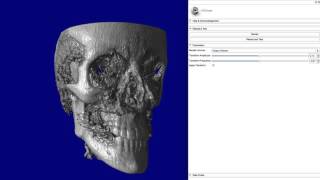
SlicerCL — 3D Slicer extensions written in OpenCL through pyopencl, including a GPU-accelerated GrowCut effect for Slicer's segmentation editor. It contributed the core idea behind
algorithms/: interactive segmentation editing expressed as GPU compute kernels, driven live from an editor UI. It also introduced the compositing renderer thatrender/follows — multiple pieces of content composited in a single ray-cast pass — along with analytic signed-distance-field compositing and ray marching through nonlinear transforms, the direct ancestors of today's Fields, SDF shells, andTransformField. This led to a proposal for CommonGL and experiments adding functionality to VTK's GLSL. -
step — GPU medical image computing in the browser with JavaScript and WebGL 2.0, working directly from DICOM-native data structures. It contributed the everything-in-the-browser premise, the patient/pixel/texture coordinate discipline and
aToBnaming conventions the renderer still uses, and the transform-composition pattern thatTransformFieldfollows today.

Beyond these direct ancestors, SlicerLive owes its deepest debt to the 3D Slicer developers and users — decades of their designs, code, and clinical-research workflows are the inspiration for, and the reference implementation behind, essentially everything here — and to the many software developers and researchers who published the algorithms and open implementations this project draws on, from ray-marched volume rendering and jump-flooding distance transforms to the ecosystem of open DICOM tooling.
Gateway: Eventually at live.slicer.org. Currently at pieper.github.io/live.
Questions? Open an issue, start a discussion, or reach out on the 3D Slicer Discourse.