Pytorch based implementation of a seq2seq machine translation model. This implementaton is based on two following papers.
- Ilya Sutskever, Oriol Vinyals, Quoc V. Le Sequence to sequence learning with neural networks
- Dzmitry Bahdanau, KyungHyun Cho, Yoshua Bengio∗ (2016) Neural machine translation by jointly learning to align and translate
The data for this project is a set of many thousands translation pairs from one language to another. Download the data from here (https://www.manythings.org/anki/)
Training was performed on Google Colaboratory platform which provides free access to GPUs. GPU Config -Tesla P100-PCIE-16GB having 2496 CUDA cores and 16GB GDDR5 VRAM.
Encoder-Decoder with attention mechanism
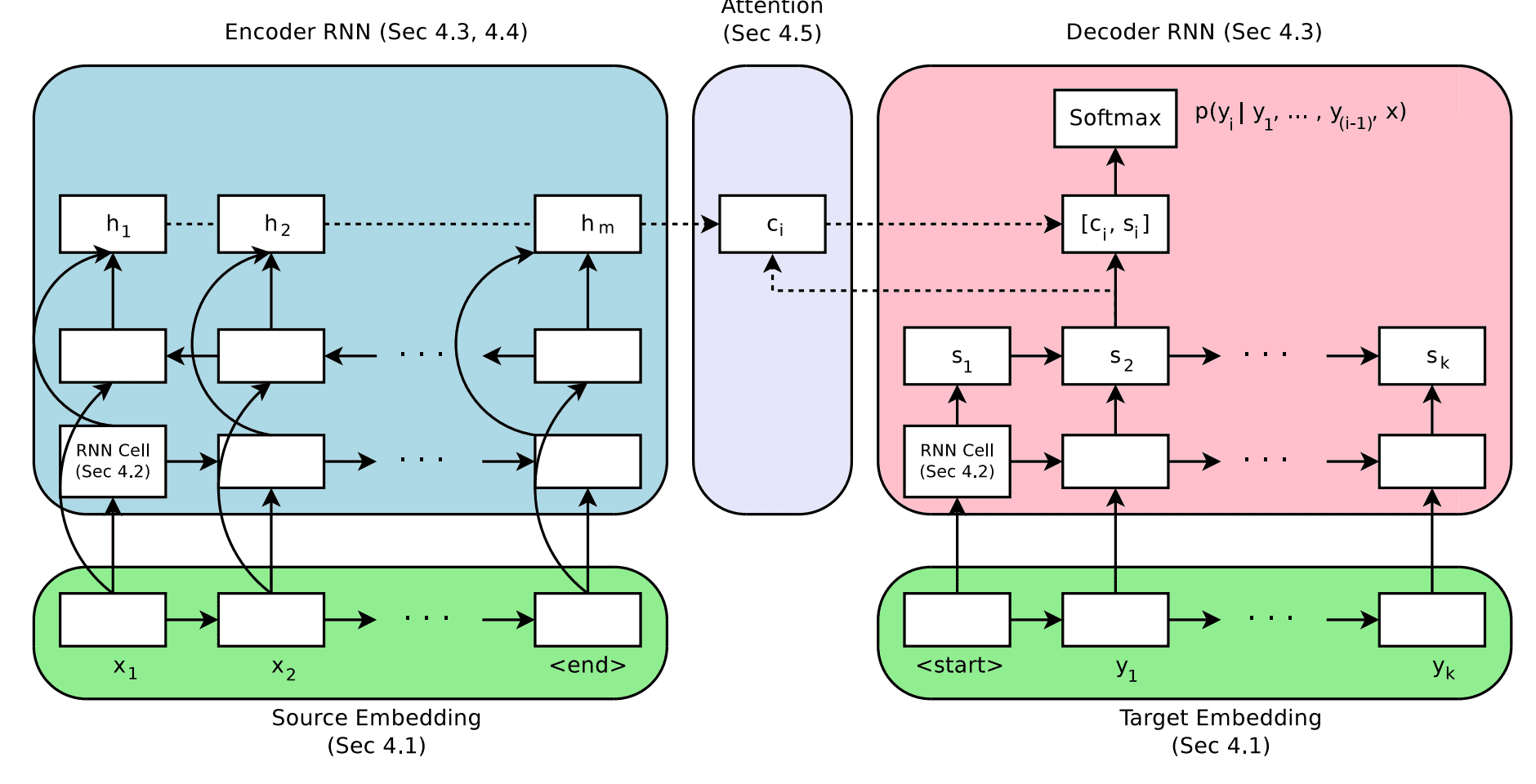

Model variants (architecture of both encoder and decoder)
- Single layer GRU
- Single layer LSTM
- 3-layered GRU
- 3-layered LSTM
Clone the entire repo. (It includes the data a well)
git clone -l -s git://github.com/pashupati98/nmt-pytorch.git cloned-repo
cd cloned-repo
ls
Default setting is for French to English translation with single layer LSTM based encoder-decoder architecture having attention mechanism. Run everything (Training and Evaluation) with just one command.
python main.py
Each model performed more or less same.

1 : Model with single layer of GRU
Model Training process

Evaluation (Attention Map)

2 : Model with single layer of LSTM
Model Training process

Evaluation (Attention Map)

3 : Model with three layers of GRU
Model Training process

Evaluation (Attention Map)

4 : Model with three layers of LSTM
Model Training process

Evaluation (Attention Map)

Conclusion - This is a very simple architecture trained a small dataset. Yet, the model has learned pretty good for small sentences. It can be futher improved by training it on large corpus.