




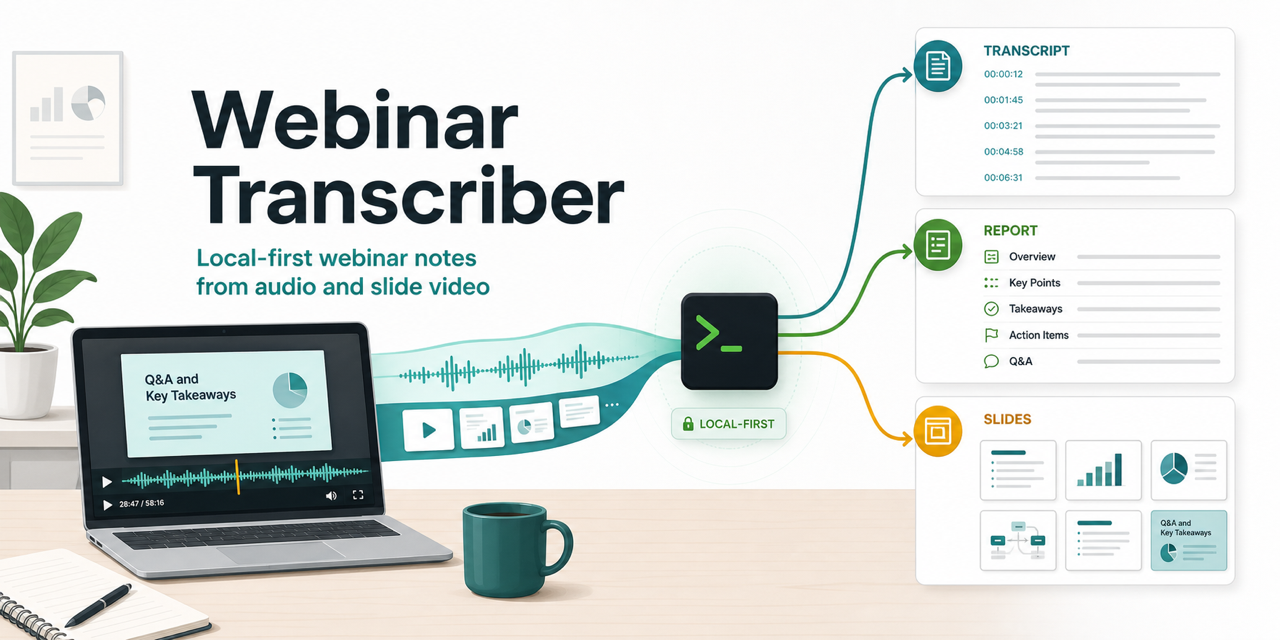
webinar-transcriber turns webinar recordings into transcripts, structured notes, diagnostics, and
machine-readable report artifacts. It accepts audio-only files and slide-based video. Video runs add
scene detection and representative frames; audio-only runs keep the same transcript and report
contract without visual context.
webinar-transcriber is local-first: speech detection, transcription, window reconciliation, and
report sectioning all run on your machine with local models and heuristics. Optional LLM refinement
runs only after that deterministic report exists; it polishes section text and refines titles,
summaries, action items, and section TL;DRs, but never replaces the base pipeline.
For per-stage detail and the artifact each stage produces, see Pipeline.
- Python 3.12+ and uv
Install the published package as a standalone CLI:
uv tool install webinar-transcriberpipx install webinar-transcriber works the same way. pip install webinar-transcriber installs
into the current environment instead of as an isolated tool.
Pin a tagged release directly from GitHub when you want a fixed version and do not need a checkout:
uv tool install --reinstall git+https://github.com/megabyde/webinar-transcriber.git@v1.3.0Replace v1.3.0 with the release tag you want. Wheel and source distribution files are also
attached to the GitHub Releases page.
From the repository root, install the local source tree as a uv tool. This registers
webinar-transcriber from the checkout; no virtual environment activation is needed. Re-run the
command after pulling changes when the installed command should track the checkout.
uv tool install --reinstall .To remove the installed tool:
uv tool uninstall webinar-transcriberProvider-backed report refinement (--llm, see Cloud LLM) needs the OpenAI and
Anthropic SDKs, which the base install omits. Append the llm extra to the package spec in
whichever install command above you used. --reinstall applies the extra whether or not the package
is already installed:
uv tool install --reinstall "webinar-transcriber[llm]"   # from PyPI
uv tool install --reinstall ".[llm]"                     # from a checkout
For a GitHub release, append the extra in the direct-reference form:
"webinar-transcriber[llm] @ git+https://github.com/megabyde/webinar-transcriber.git@v1.3.0".
Caution
CUDA installs rebuild pywhispercpp locally and depend on the host CUDA toolkit. Use the standard
install unless you specifically need NVIDIA acceleration.
CUDA is the only supported path that builds pywhispercpp from source. It requires
CMake, a C/C++ compiler, and a working
CUDA toolkit with nvcc on PATH and CUDA_HOME
set.
Install the CLI tool with CUDA support:
GGML_CUDA=1 uv tool install --reinstall . \
    --reinstall-package pywhispercpp \
    --no-binary-package pywhispercpp
If the build fails, see CUDA install fails. For a CUDA-enabled development checkout, see Development.
By default, each input gets a fresh run directory under runs/. Multiple inputs are processed
sequentially. --output-dir is allowed only with one input.
The CLI accepts any container PyAV can decode when it contains an audio stream, including .mp4,
.mkv, .mov, .webm, .mp3, .wav, and .m4a. A video stream is optional; when present, it
adds scene detection and representative frames.
Tip
Use a fresh --output-dir for reproducible comparisons. Existing output directories are refused,
not overwritten.
webinar-transcriber INPUT
webinar-transcriber INPUT1 INPUT2 INPUT3
webinar-transcriber INPUT --keep-audio
webinar-transcriber INPUT --output-dir runs/custom-demo--llm enables provider-backed report refinement after deterministic sectioning. The LLM step can
polish section transcript text with light cleanup and paragraphing, and refine summary bullets,
action items, section titles, and section TL;DRs. Supported providers are openai and anthropic;
OpenAI is the default.
This step needs provider SDKs that the base install omits. Install them with the llm extra (see
Cloud LLM extra under Install).
Important
--llm sends report text, section timing metadata, and transcript excerpts to the configured
provider. It does not send the local source path. Do not use it for recordings that must stay
entirely local.
Configure the provider with environment variables:
LLM_PROVIDER:openai(default) oranthropic.OPENAI_API_KEY/OPENAI_MODEL: API key and model identifier for the OpenAI provider.ANTHROPIC_API_KEY/ANTHROPIC_MODEL: API key and model identifier for the Anthropic provider.
The CLI does not pin a default model name for either provider; pass any model the provider supports.
OPENAI_API_KEY=... \
    OPENAI_MODEL=<openai-model> \
    webinar-transcriber INPUT --llm
LLM_PROVIDER=anthropic \
ANTHROPIC_API_KEY=... \
ANTHROPIC_MODEL=<anthropic-model> \
webinar-transcriber INPUT --llmFor missing environment variables, missing extras, or unsupported provider names, see Troubleshooting.
Pass --diarize to label transcript segments with anonymous local speaker IDs:
webinar-transcriber INPUT --diarize
webinar-transcriber INPUT --diarize --diarize-speakers 4
Warning
Pass --diarize-speakers only when the exact speaker count is known. A wrong count can force poor
speaker labels. Omit the option to let Sherpa estimate the count.
Diarization runs locally through sherpa-onnx and does not use an API key. The first diarized run
downloads the segmentation and speaker-embedding models into
~/.cache/webinar-transcriber/diarization. Set WEBINAR_DIARIZATION_CACHE_DIR to override that
cache directory.
When diarization is enabled, reports label each speaker turn with stable anonymous labels ordered by
first appearance in the timeline: S1, S2, and so on (one label per turn, even when a turn spans
several paragraphs). JSON artifacts include a speaker field on transcript segments and a separate
diarization.json file with raw speaker turns. If labels look wrong, see
Poor diarization labels.
webinar-transcriber uses pywhispercpp to resolve whisper.cpp models. By default it uses
large-v3-turbo (downloaded on the first transcription run, not during installation). You can pass
another model identifier or a local GGML model path with --asr-model.
webinar-transcriber INPUT --asr-model large-v3-turbo
webinar-transcriber INPUT --asr-model large-v3
webinar-transcriber INPUT --asr-model models/whisper-cpp/ggml-large-v3-turbo.bin
To manage the model file yourself, download it directly:
mkdir -p models/whisper-cpp
curl -L \
    -o models/whisper-cpp/ggml-large-v3-turbo.bin \
    https://huggingface.co/ggerganov/whisper.cpp/resolve/main/ggml-large-v3-turbo.bin
Use --asr-model large-v3 when transcription accuracy matters more than local runtime.
The default ASR path uses the selected whisper.cpp model, automatic language detection, and an
automatically selected thread count.
--language CODE: force a Whisper language code such asenorru.--threads N: set the CPU worker count passed towhisper.cpp.
GPU-enabled builds can offload supported model work to the GPU, but whisper.cpp still uses CPU
threads for scheduling, language detection, and non-offloaded work. The same --threads value is
also used by local VAD, local diarization, and concurrent LLM section polishing. By default, the CLI
uses the host CPU count capped at 8. Lower it when the machine needs CPU capacity for other work.
Common errors and their fixes, indexed by the message the CLI prints, live in Troubleshooting.
Successful runs can write:
runs/<timestamp>_<basename>/
├─ metadata.json             # probed media type, duration, streams
├─ transcript.json           # reconciled transcript with timestamps and optional speakers
├─ report.md
├─ report.docx
├─ report.json               # final report in markdown, docx, and json
├─ diagnostics.json          # stage timings, counts, warnings, ASR and optional LLM info
├─ asr/
│  ├─ speech_regions.json    # VAD ranges
│  └─ decoded_windows.json   # per-window decode output
├─ diarization.json          # anonymous speaker turns; --diarize only
├─ scenes.json               # scene boundaries; video only
├─ frames/                   # representative frames; video only
└─ transcription-audio.mp3   # normalized audio copy; --keep-audio only
Failed runs still write diagnostics.json with the failed stage and any partial intermediate
artifacts already produced, as long as the run directory exists.
Checkout setup, running from source, the make target reference, and the quality gate live in Development. Coding conventions, testing notes, and the Definition of Done live in AGENTS.md.