Local browser UI for the pi coding agent. Pi Web uses the same local configuration and session files as pi, so you can browse and resume conversations, run agent turns, configure models and resources, and inspect project files from a browser.
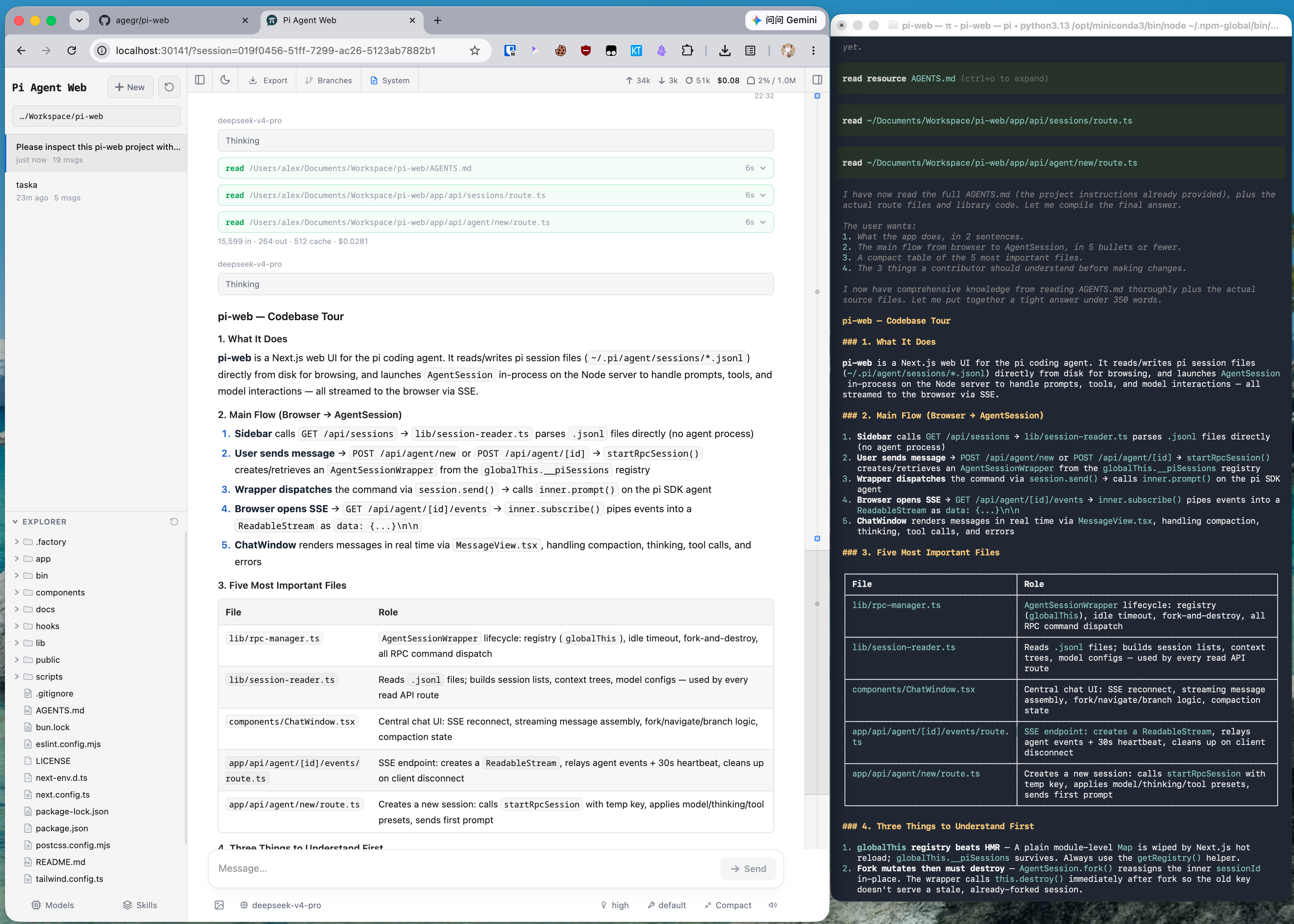
- Session workspace: browse, resume, rename, export, and delete conversations grouped by project, with running state, context usage, cost, and compaction details.
- Two ways to branch: New session creates an independent session file from an earlier message; Edit from here creates a branch inside the current session.
- Project file tools: browse and upload files, inspect Git diffs, and preview source, Markdown, images, audio, PDFs, and DOCX files with automatic refresh.
- Git worktrees: switch checkouts from the sidebar while keeping sessions from the same repository grouped together.
- Web-based configuration: manage provider login and API keys, models, model tests, plugin packages, and skills without leaving Pi Web.
- English, Simplified Chinese, and Traditional Chinese UI: Pi Web follows the browser language initially and provides a language switcher in the top bar.
- Offline voice dictation: transcribe speech locally with whisper.cpp — see Dictation.
Pi Web requires Node.js 22.19.0 or newer. Check your version with node --version, then run:
npx @agegr/pi-web@latestThe CLI opens a browser after the server is ready. If it does not, open http://127.0.0.1:30141. Pi Web listens only on 127.0.0.1 by default.
If no model provider is configured yet, open the Models panel to sign in or add an API key.
To install the pi-web command globally:
npm install -g @agegr/pi-web@latest
pi-web
To update, stop the running process with Ctrl+C and run the same install command again. To uninstall, run npm uninstall -g @agegr/pi-web.
For port and hostname, command-line options override the corresponding environment variables. Either --no-open or PI_WEB_NO_OPEN=1 disables automatic browser opening. Run pi-web --help (or -h) to print startup options and exit without starting the server. Unknown options exit with an error.
| Option or environment variable | Purpose | Default |
|---|---|---|
--help, -h |
Print startup options and exit | — |
--port <port>, -p <port>, or PORT |
Server port | 30141 |
--hostname <host>, -H <host>, or PI_WEB_HOSTNAME |
Bind hostname | 127.0.0.1 |
--no-open or PI_WEB_NO_OPEN=1 |
Do not open a browser automatically | Browser opens |
PI_WEB_SKIP_VERSION_CHECK=1 |
Disable Pi Web update checks | Unset |
PI_WEB_ALLOWED_HOSTS |
Additional exact proxy or custom hostnames, comma-separated | Unset |
PI_WEB_PASSWORD |
Enable HTTP Basic Auth; the username is always pi |
Authentication disabled |
For example:
pi-web --help
pi-web -p 8080 -H 0.0.0.0 --no-openBinding to a non-loopback address exposes an agent that can execute high-privilege actions. On a trusted LAN, require a long random password:
PI_WEB_PASSWORD='a-long-random-password' pi-web --hostname 0.0.0.0Basic Auth does not encrypt the password in transit. Do not expose Pi Web over plain HTTP to the internet; use HTTPS through a trusted reverse proxy or a trusted VPN. If a reverse proxy sends an external hostname, add that exact name to PI_WEB_ALLOWED_HOSTS. This allow-list does not change the address Pi Web binds to.
Server-side model and API requests honor the standard HTTP_PROXY, HTTPS_PROXY, and NO_PROXY environment variables.
On macOS or Linux:
HTTP_PROXY=http://127.0.0.1:7890 \
HTTPS_PROXY=http://127.0.0.1:7890 \
NO_PROXY=localhost,127.0.0.1 \
npx @agegr/pi-web@latest
On Windows PowerShell:
$env:HTTP_PROXY = "http://127.0.0.1:7890"
$env:HTTPS_PROXY = "http://127.0.0.1:7890"
$env:NO_PROXY = "localhost,127.0.0.1"
npx @agegr/pi-web@latestPi Web can transcribe your voice entirely on-device with whisper.cpp: click the microphone in the chat input, speak, click again to stop, and the text is inserted at the cursor. No audio leaves the machine. When the engine or a model is missing, Pi Web reports the service unavailable and hides the microphone.
Dictation runs from this repository's source. Install the local engine and a model once with:
npm run setup:whisper            # default base.en model (~140 MB)
npm run setup:whisper tiny.en    # smaller and faster (~77 MB)
npm run setup:whisper small.en   # more accurate (~466 MB)
Installed models are switchable from the selector next to the microphone.
- Install the build tools once:
xcode-select --install, thenbrew install cmake. - Clone this repository, run
npm install, thennpm run setup:whisper. On macOS this buildswhisper-serverfrom source and downloads the model. - Start Pi Web on localhost with
npm run devand allow microphone access when prompted.
Keep Pi Web on http://127.0.0.1:30141 (a secure context) — Safari and Chrome refuse microphone access over a plain LAN address such as http://192.168.x.x. For LAN use, front it with HTTPS.
The whisper-server binaries ship with this repository, so setup only downloads the model:
npm run setup:whisperThe bundled binaries need the Microsoft Visual C++ Redistributable, already present on most machines.
Same as macOS, using your package manager for the toolchain:
sudo apt install cmake build-essential   # or the equivalent for your distro
npm run setup:whisper
Engine and model locations resolve in this order, defaulting to the repo-local whisper/ directory:
WHISPER_SERVER_PATH— path to thewhisper-serverbinaryWHISPER_MODEL_DIR— directory containingggml-*.bin/*.ggufmodelsWHISPER_VTT_ROOT— legacy single-root override (whisper-cli/Release/whisper-server.exe+models/)WHISPER_HOST/WHISPER_PORT— bind address and port (default127.0.0.1:8765)
- Agent data: Pi Web reads pi data from
~/.pi/agentby default, including session files undersessions/<encoded-cwd>/<timestamp>_<uuid>.jsonl. SetPI_CODING_AGENT_DIRto use another pi agent directory. - Filesystem access: Pi Web must be able to read the agent data directory and the working directories recorded by its sessions. Run Pi Web in the same filesystem environment as pi when sharing existing sessions.
- Shared configuration: the Models panel uses pi's model, settings, and credential storage, so changes are visible to both interfaces.
- File access boundary: the file browser is limited to working directories selected in Pi Web and project or session roots it already knows about; it is not a general filesystem browser.
- Git worktrees: see Worktrees in Pi Web for switcher visibility, worktree creation, and removal behavior.
Electron wrappers and other downstream integrations can provide a session-row
context menu without patching SessionSidebar. Listen for the cancelable
pi-web:session-row-contextmenu browser event and call preventDefault()
synchronously when the integration will handle it:
window.addEventListener("pi-web:session-row-contextmenu", (event) => {
  event.preventDefault();
  const { id, path, cwd, name, clientX, clientY, refresh } = event.detail;

  void openSessionMenu({ id, path, cwd, name, clientX, clientY }).then((changed) => {
    if (changed) refresh();
  });
});
The detail object contains id, path, cwd, optional name, pointer
coordinates, and a refresh() callback for actions that change the session
list. If no listener cancels the extension event, Pi Web preserves the
browser's native context menu. This hook is browser-side and independent of
Pi agent extensions.
npm install
npm run dev
The development server runs at http://127.0.0.1:30141. Run the common checks with:
npm test
node_modules/.bin/tsc --noEmit
npm run lint
Do not run next build or npm run build during normal development. It writes to .next/ and can interfere with the development server; leave builds for release work.
Contributor guides: Internationalization and Release process.
app/             Next.js UI and API routes
components/      React UI components
hooks/           Client state and interaction hooks
lib/             Session, agent, model, file, Git, and security logic
public/          Static assets and PWA files
bin/             npm CLI entrypoint and launch option parsing
docs/            Focused user and contributor guides
See AGENTS.md for the architecture notes and detailed file map.