






A terminal coding agent built on
everruns-host. One binary
that plans, edits, runs, and verifies code in your repository, autonomous by
default, with persistent sessions, agent skills, MCP servers, and editor
integration over the Agent Client Protocol.
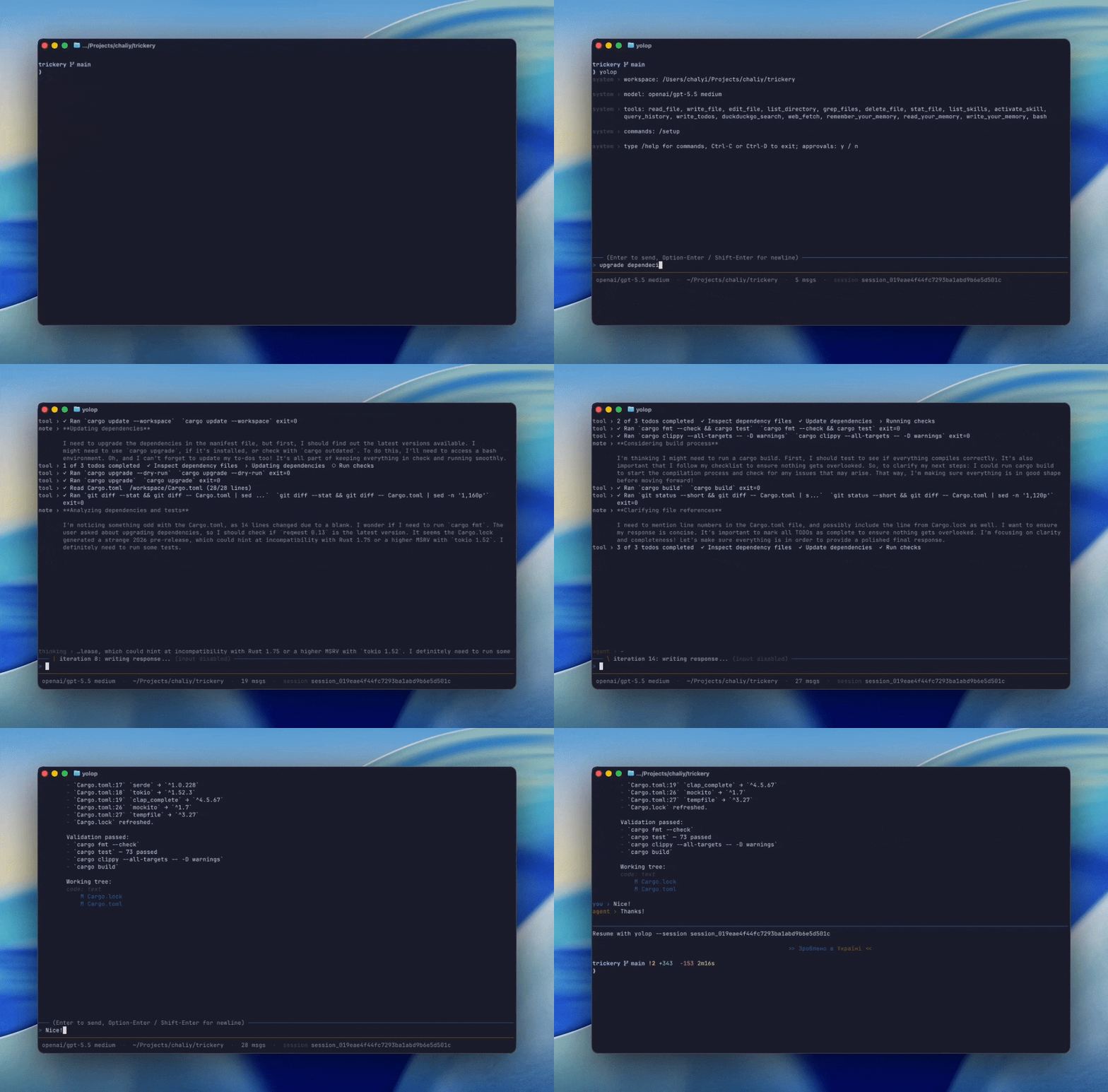
yolop comes from the Ukrainian Йолоп: a dummy, fool, or not-too-bright
person. The name was meant to sound clever and funny in Ukrainian while also
describing the agent's starting point: Yolop avoids per-tool approval pop-ups.
Routine workspace work runs automatically; hard prompts are reserved for the
configured shell boundary, with soft approval for critical
moments that need spoken consent and an audit trail.
brew install everruns/tap/yolopWorks on macOS (arm64/x86_64) and Linux (x86_64). If your Homebrew enforces
tap trust checks, run brew trust --tap everruns/tap once first. Building from
source instead? cargo install yolop --locked.
cd your/repo
yolop
First launch with no credentials opens a guided, keyboard-driven setup: provider → credentials → model. Or set a provider key and go:
OPENAI_API_KEY=sk-… yolop

yolop -C /path/to/repo                  # work in a different workspace
yolop -p "summarize the build setup"    # one-shot, prints to stdout, no TUI
yolop --provider llmsim -p "hi" # offline demo, no API key required- Unrestricted by default: shell commands get full host access unless you
opt into
workspace-writecontainment with--sandboxor thesandbox_modesetting. A standing write blocklist always rejects writes into.git/,node_modules/,target/, and similar build/dependency directories; reads inside the workspace stay unrestricted. - Shell sandboxing: sandboxed commands run under Seatbelt on macOS or
Landlock + seccomp on Linux. Choose a sandbox mode (
read-only,workspace-write, ordanger-full-access, the default) and an approval policy (untrusted,on-failure,on-request, the default, ornever) independently. See Shell sandboxing. - Soft approval: an optional spoken-consent layer: yolop batches safe work
and pauses, in plain chat, only before destructive or outward-facing steps;
you approve by replying "yes". Set the level with
/setup approval <protective|normal|off>or just tell yolop to be more or less careful. See Soft approval and Approvals. - TUI chat (ratatui), scrolling transcript with tree-sitter syntax
highlighting of fenced code blocks, a multiline composer, a live status bar,
slash commands (
/help,/tools,/mcp,/setup,/model,/goal,/shell,/background, …), aCtrl+Bactivity rail for agents, background commands, and monitors with branch usage and cooperative cancellation,!<command>as a direct shell shortcut,@-triggered file-path completion, and shell-style history recall (↑/↓,Ctrl+R) persisted across sessions. Fullscreen runs replace per-turn narration and tool lines with one live summary by default;Ctrl+Oexpands or collapses the retained details. Pass--no-compact-workto retain ordinary transcript rows. Compact work is fullscreen-only because native inline scrollback cannot repaint old rows. - Side questions:
/btw <question>answers out-of-band using the current session context, with no tools and nothing added to conversation history. - Goal loops:
/goal <condition>keeps working across turns until a separate evaluator model confirms the condition;/goal clearstops early. Works in--printmode too. - User-ask tracking (experimental, off by default), records the current
request across turns and applies bounded completion checks. Enable with
[[capabilities]] ref = "yolop_user_ask"insettings.toml. - Planning:
write_todoskeeps multi-step tasks on track, and loop detection stops the model from retrying the same failing tool call. - One-shot mode:
--printruns a single prompt non-interactively, for scripts and CI.
- Filesystem:
read_file,write_file,edit_file,list_directory,grep_files,delete_file,stat_file, backed by the real workspace disk. - Repo map:
repo_mapandrepo_symbolsbuild an on-demand multi-language symbol overview for orientation before targeted grep/read. See Repo map. - AST grep:
ast_grepruns read-only structural pattern search across Rust, Python, TypeScript/TSX, JavaScript/JSX, C#, Go, CSS, HTML, and Bash. - AST edit (optional, off by default),
ast_editapplies pattern rewrites with a preview-firstdry_runflow. Enable with[[capabilities]] ref = "ast_edit"insettings.toml. - LSP (optional, off by default), real language servers (rust-analyzer,
typescript-language-server, pyright, gopls, clangd, or any configured binary)
behind
lsp_diagnostics,lsp_definition,lsp_references,lsp_hover,lsp_rename(workspace-wide),lsp_symbols, andlsp_code_actions. Enable with[[capabilities]] ref = "lsp"insettings.toml. - Shell:
bash -lcfrom the workspace root, with a 120 s timeout and a 1 MiB per-stream output cap (overflow spills to the session folder and stays readable for tool calls). Run a command directly with/shell <command>or!<command>. - Background tasks:
spawn_backgroundruns a shell command detached from the current turn (e.g. watching CI): it streams to a log, writes aresult.json, and tracks a session task you inspect withlist_tasks,get_task, andcancel_task(or the/backgroundcommand and interactiveCtrl+Bactivity rail). Detached commands may run up to 24 hours and their results survive a restart.spawn_backgroundcan also schedule one-shot or recurring monitors; when a schedule fires or a task finishes while the session is idle, yolop proactively wakes the agent (disable withproactive_wake). - Sub-agents:
spawn_agentdelegates independent work into child context windows. A two-level hierarchy supports broad swarms without exceeding the per-session fan-out limit;Ctrl+Bshows the live activity rail with branch token and cost rollups. See Parallel sub-agents. - Session coordination: a purpose-built coordinator profile can discover
live, opt-in Yolop workers in separate Git worktrees, dispatch durable tasks,
and receive explicit completion wakes through the attached
yolop coordinationCLI, without adding model-tool schemas. Presence and delivery are local and restart-safe; ordinary sessions start drained. See Session coordination. - Web:
free_web_search,web_fetch(HTTP GET/HEAD with markdown/text conversion and DNS-pinned SSRF protection), andduckduckgo_instant_answer, all working without an API key. SetEVERRUNS_SYSTEM_ALLOWLIST_ENABLED=trueto restrictweb_fetchto a curated allowlist of well-known public resources.
AGENTS.md: project instructions re-read every turn.- Workspace context: root, shell, local date/timezone, and Git identity/branch injected automatically.
- Memory: a structured
MEMORY.mdof durable, cross-session memories, managed in natural language ("remember that I prefer terse answers") via theremember/recall/forgettools. Only titles are injected each turn; bodies are recalled on demand, so the prompt stays small however much you remember. - Skills:
SKILL.mdfiles discovered from workspace (.agents/skills/), global, ephemeral environment, and bundled scopes. Model-visible discovery and activation use upstreamlist_skillsandactivate_skill; package management usesyolop skills. Skills installed after startup are available immediately. See Registry skills and Mermaid diagrams. - OKF knowledge: a bundled
okfskill for the Open Knowledge Format: read, author, convert to, and validate knowledge bundles. See OKF. - Herdr-aware sessions: when launched in a Herdr pane, Yolop reports
working/idle/blockedlifecycle states and exposes read-only Herdr guidance without installing a global skill. - Infinity context: older history is trimmed out of the live prompt but
stays queryable via
query_history, so long sessions don't hit the wall. - Tool search: core file/shell tools stay loaded while long-tail tools are hidden until the model pulls them in, saving input tokens on every provider.
- Compaction & caching: at 85% of the model's context window, supported providers replace old input with a native compact checkpoint plus the new suffix (raw history stays lossless and searchable), and Anthropic prompt-caching markers are emitted out of the box.
- Extensions: installable capability packages that add tools, prompt
guidance, MCP servers, and hooks without rebuilding yolop, over the yolop
extension protocol (YEP). Install from crates.io with no Rust toolchain, a git
URL, or a local path with
yolop extensions; direct foreground invocations from a running Yolop session also update that session without exposing management tools to the model. The built-in/extensionscommand uses the same grammar inside interactive clients. Author one with theyolop-yepSDK. See docs/extensions.md. - MCP servers: extra tools from local (stdio) or remote (HTTP) Model Context Protocol servers. See MCP servers.
- Hooks: workspace and global hooks can block, mutate, or audit agent
actions. Configure them by chatting with yolop or by editing
hooks.json. See docs/features/hooks.md. - Editor integration:
--acpspeaks the Agent Client Protocol over stdio, so editors such as Zed can drive yolop. See Editor integration. - Sessions & rewind: a durable per-session event log with auto-generated
titles; resume any conversation with
--session <id>. Every turn gets a checkpoint, and/undo,/redo, and/rewindrestore conversation or workspace state without touchingHEADor the Git index. See Session persistence. - Session search:
search_sessionsfinds recent local sessions by a distinctive phrase, keeping investigations grounded in the saved event log.
| Provider | Credential | Default model |
|---|---|---|
| OpenAI | OPENAI_API_KEY |
gpt-5.6-sol |
| Codex subscription | browser/device ChatGPT login or CODEX_ACCESS_TOKEN |
gpt-5.6-sol |
| Anthropic | ANTHROPIC_API_KEY |
claude-opus-5 |
| Meta Model API | MODEL_API_KEY |
muse-spark-1.2 |
| OpenRouter | browser PKCE login or OPENROUTER_API_KEY |
openai/gpt-5.6-sol |
GEMINI_API_KEY / GOOGLE_API_KEY |
gemini-2.5-flash |
|
| Ollama | OLLAMA_BASE_URL / OLLAMA_API_KEY |
llama3.2 |
| Local (in-process) | none (weights pulled with yolop weights pull) |
Qwen3-30B-A3B-Instruct Q4 GGUF |
| Custom | CUSTOM_BASE_URL (+ optional CUSTOM_API_KEY) |
, (set via /setup) |
| llmsim | none (offline simulator) | , |
Pick explicitly with --provider, override the model with -m/--model. Codex
subscription signs in through ChatGPT and uses the Codex backend directly.
OpenRouter can mint a user-controlled API key through the same /setup
browser login, or you can paste/OPENROUTER_API_KEY as before. Custom is
any OpenAI-compatible Chat Completions endpoint (vLLM, llama.cpp, LM Studio,
hosted gateways, …).
Local (in-process) is experimental. Unlike Ollama it needs no server: the
inference engine is linked into yolop. Model specs are Hugging Face repos
(Qwen/Qwen3-8B) or a GGUF file inside one
(unsloth/Qwen3-8B-GGUF::Qwen3-8B-Q4_K_M.gguf). Pull the weights before use —
a turn never blocks on a download:
M=unsloth/Qwen3-8B-GGUF::Qwen3-8B-Q4_K_M.gguf
yolop weights pull "$M"     # several GB, with progress
yolop weights list          # what is on disk, and how much
yolop weights rm "$M"       # reclaim it
yolop --provider local -m "$M"
The default is Qwen3-30B-A3B-Instruct at Q4 (~19 GB): a mixture of experts
with only ~3B parameters active per token, so it runs at roughly small-model
speed on Apple Silicon, where memory bandwidth rather than compute is the
limit. Budget 32 GB of RAM. /setup also lists an 8B at ~5 GB, which is
quicker to pull and quicker to load when you are iterating.
Qwen3-Coder-30B-A3B is deliberately not the default despite being the
better-aimed model: its chat template emits tool calls as
<tool_call><function=…> XML, and the engine only parses JSON inside
<tool_call>, so none of its tool calls would be understood.
Weights live under <data_dir>/yolop/models/. How well a local model actually
drives the agent loop is the open question this is here to answer.
The engine is not in the default build, so brew install and
cargo install yolop --locked do not carry it. Each release ships a second,
GPU-accelerated binary per target that does:
| Download | Needs |
|---|---|
yolop-aarch64-apple-darwin-metal.tar.gz |
Apple Silicon |
yolop-x86_64-apple-darwin-metal.tar.gz |
Intel Mac |
yolop-x86_64-unknown-linux-gnu-cuda.tar.gz |
NVIDIA GPU, Ampere or newer |
Grab one from the latest release,
or build it yourself. The backend is a feature that implies local-inference
and needs its vendor toolchain:
cargo install yolop --locked --features metal   # macOS
cargo install yolop --locked --features cuda    # NVIDIA, needs the CUDA toolkit
There is no CPU-only engine build to download. An 8B model on the CPU is slow
enough to read as "local models are useless" when the real finding is "this was
never accelerated", so cargo install yolop --locked --features local-inference
is there if you want it, but it is not something to ship.
On by default. When yolop creates commits it keeps your git identity and appends
Co-Authored-By: yolop <yolop@everruns.com> once; PR descriptions created through
gh get a Produced by [yolop](https://everruns.com/yolop) footer. Disable with
/setup attribution off.
Soft approval is prompt-engineering, not a hard gate: yolop is told to batch safe work and pause for spoken consent only at critical moments. The model decides what is critical; you approve in plain language ("yes", "approved"); each grant is recorded to the session event log for audit. There is no separate approval UI, consent lives in the conversation.
A single approval_mode level tunes how cautious yolop is:
| Level | yolop pauses before… |
|---|---|
protective |
any state-changing action (writes, commits, pushes, installs) |
normal |
only destructive/irreversible or outward-facing actions (the default) |
off |
nothing, fully autonomous, no soft-approval prompt |
The current level shows in the status bar. Change it with
/setup approval <level>, or just ask yolop to be more or less careful ("yolo
mode"); the choice persists in settings.toml. Soft approval is judgement, not
a guarantee, native shell sandboxing supplies the kernel boundary and hooks can
block specific operations. See
Shell sandboxing and
Approvals.
yolop implements the agent side of the Agent Client
Protocol. Launch it with --acp and it speaks
newline-delimited JSON-RPC 2.0 over stdin/stdout: the editor handshakes, opens a
session, and sends turns; yolop streams back assistant text, reasoning, tool
calls, plans, and session-title changes. Editors can also load an existing
session with session/load, replaying the same persisted history used by CLI
--session.
ACP model pickers list only providers that are currently connected. A stale
saved provider no longer prevents session creation: yolop starts with another
usable provider (or local llmsim) and updates the picker live after /setup
or authentication changes. Clients that support ACP authentication can launch
Yolop's browser-based ChatGPT/Codex sign-in directly from the agent UI. API-key
providers must receive their keys through the ACP process environment; Yolop
does not accept secrets through ACP prompt text. Model tools that require a
credential argument, such as connector connect, are not exposed in ACP.
MCP configuration accepts environment placeholders but rejects literal
credential-bearing headers and environment values.
ACP checkpoint commands restore workspace state only. Conversation rewind is not offered because ACP cannot replace messages already displayed by the editor; use the TUI when the transcript and model history must both rewind.
An experimental opt-in adds a second route for those providers: an extra ACP
authentication method that opens a short-lived setup page on 127.0.0.1, where
an API key, a custom endpoint, or a model can be entered in the browser instead
of the editor. The key goes straight into yolop's settings, never through the
editor or the session log. Sessions started with nothing connected also get a
link to that page. Turn it on for one run with yolop --acp --acp-setup-page,
or for every launch by setting acp_setup_page (ask yolop to turn it on, or use
/yolop-config). Editors own the spawn arguments, so the setting is usually the
practical one. It is off by
default, and it needs the editor to be on the same machine as yolop.
To set up Zed:
yolop into zedThat adds a custom ACP agent server to ~/.config/zed/settings.json using the
current yolop executable (preserving any existing env on re-run). Then pick
yolop in Zed's agent panel.
To set up Buzz Desktop:
yolop into buzzThat adds a custom harness under Buzz's application data directory using the
current yolop executable and --acp. Re-running updates the managed fields while
preserving any custom env values and extension fields.
Yolop pulls in extra tools from MCP servers, remote (Streamable HTTP) and
local (stdio), configured in the standard .mcp.json shape. Two scopes are
merged, workspace overriding global by name:
- workspace:
<workspace_root>/.mcp.json - global:
<config_dir>/yolop/mcp.json(e.g.~/.config/yolop/mcp.json)
{
  "mcpServers": {
    "docs": {
      "type": "http",
      "url": "https://example.com/mcp",
      "headers": { "Authorization": "Bearer ${DOCS_TOKEN}" }
    },
    "fs": {
      "type": "stdio",
      "command": "mcp-server-filesystem",
      "args": ["${WORKSPACE}"],
      "env": { "RUST_LOG": "info" }
    }
  }
}typedefaults tohttp; HTTP servers need aurl, stdio servers acommand.- String values support
${VAR}expansion from the environment, so secrets stay out of the file (an unset${VAR}is left as-is). - Discovered tools are exposed as
mcp_<server>__<tool>.
Manage servers from the CLI with yolop mcp, or from a session with /mcp:
yolop mcp list --scope effective
yolop mcp add linear --scope global --type http --url https://mcp.linear.app/mcp --auth-mode oauth --oauth-provider-id linear
yolop mcp enable linear --scope global
yolop mcp remove linear --scope global
In a session, /mcp lists startup servers and
/mcp enable|disable|remove <name> [global|workspace] updates the config;
changes take effect in the next session.
Trust model: HTTP requests keep yolop's DNS-pinned SSRF protection; stdio
servers run local processes you listed yourself, so authoring .mcp.json is the
act of consent. MCP tools run autonomously like the rest of yolop's tools.
| Flag | Description |
|---|---|
-C, --cwd <PATH> |
Workspace root (default: current dir) |
--provider <P> |
Force anthropic, meta, codex, openai, google, openrouter, ollama, local, custom, or llmsim |
--profile <NAME> |
Overlay a named execution profile from the platform config directory |
-m, --model <ID> |
Override the model id for the chosen provider |
-p, --print <PROMPT> |
Run one prompt non-interactively and print the result |
--acp |
Speak the Agent Client Protocol over stdio (for editors like Zed) |
--session <ID> |
Resume a previous session by id |
--session-dir <PATH> |
Override the parent directory for session folders |
--config-dir <PATH> |
Override the global config directory (settings, profiles, extensions) |
--data-dir <PATH> |
Override the global data directory (sessions, logs, models) |
--sandbox |
One-run workspace-write containment without changing settings |
--no-compact-work |
Retain each fullscreen turn's work as ordinary transcript rows |
--reasoning-effort <E> |
Reasoning effort override when the model profile supports it |
--trajectory-out <PATH> |
Write the session as an ATIF v1.7 trajectory JSON at end of run |
| Command | Description |
|---|---|
yolop version |
Print yolop, commit, and runtime versions |
yolop into zed |
Configure yolop as a custom ACP agent in Zed |
yolop into buzz |
Configure yolop as a custom ACP harness in Buzz |
yolop mcp … |
Manage MCP servers (see MCP servers) |
RUST_LOG is honored for the underlying tracing layer. Non-interactive modes
write traces to stderr. Interactive sessions keep terminal rendering clean and
write traces to private, rotating files under <data_dir>/yolop/logs/ (the five
most recent files are retained, capped at 4 MiB each).
| Env var | Effect |
|---|---|
OPENAI_API_KEY |
Select OpenAI unless --provider overrides |
CODEX_ACCESS_TOKEN |
Select Codex subscription auth |
ANTHROPIC_API_KEY |
Select Anthropic when OpenAI is not configured |
MODEL_API_KEY |
Select Meta Model API when earlier providers are not configured |
OPENROUTER_API_KEY |
Select OpenRouter when earlier providers are not configured |
GEMINI_API_KEY / GOOGLE_API_KEY |
Select Google Gemini via its OpenAI-compatible endpoint |
OLLAMA_BASE_URL |
Select Ollama, defaults to http://127.0.0.1:11434/v1 |
CUSTOM_BASE_URL |
Select the custom OpenAI-compatible endpoint |
EVERRUNS_CLI_MODEL |
Override the auto-selected default model |
EVERRUNS_CLI_REASONING_EFFORT |
Reasoning effort override when the model profile supports it |
Each provider also accepts an optional base-URL / key override
(OPENROUTER_BASE_URL, GOOGLE_BASE_URL, OLLAMA_API_KEY, CUSTOM_API_KEY).
At runtime the per-provider env var always beats a saved token, so a per-run
override is always possible.
A TOML file at <config_dir>/yolop/settings.toml persists your preferred
provider, per-provider model picks, custom base URLs, the soft-approval level,
sandbox mode and approval policy, Codex login metadata, and (optionally) API
tokens (~/.config/yolop/settings.toml on Linux,
~/Library/Application Support/yolop/settings.toml on macOS,
%APPDATA%\yolop\settings.toml on Windows).
You rarely edit it by hand: the TUI's /setup, /model, and /effort commands
update the active provider, keys, model, and reasoning effort, and yolop can read
and manage persistent model selection through
yolop config model show|set|clear or the yolop-config skill. Unknown keys are
ignored, so the format stays forward-compatible.
Both global directories can be moved: --config-dir <PATH> (settings, profiles,
hooks, extensions) and --data-dir <PATH> (sessions, logs, models, prompt
history), or YOLOP_CONFIG_DIR / YOLOP_DATA_DIR for a whole shell. Point both
somewhere private to run isolated or side-by-side yolop identities without
moving HOME (global skills stay in the cross-agent ~/.agents/skills, which
YOLOP_GLOBAL_SKILLS_DIR moves separately):
yolop --config-dir ~/agents/triage/config --data-dir ~/agents/triage/dataNamed profiles are sparse execution overlays stored under
<config_dir>/yolop/profiles/<name>.toml and selected explicitly with
--profile <name>. A profile bundles provider/model choices, endpoint base
URLs, approval and sandbox settings, worktree behavior, the harness capability
set (which is also how extensions are enabled or disabled), MCP servers, extra
skills, and standing instructions, so one profile can define a purpose-built
agent without duplicating global settings:
# profiles/triage.toml
default_provider = "openai"
approval_policy = "never"
sandbox_mode = "read-only"
instructions_file = "triage/INSTRUCTIONS.md"

[models]
openai = "gpt-5.6 xhigh"

# Only these MCP servers, not the global set.
mcp_mode = "replace"

[mcp.servers.inbox]
type = "http"
url = "https://inbox.example/mcp"

# Turn an extension on for this profile and a default capability off.
[[capabilities]]
ref = "ext:triage"

[[capabilities]]
ref = "yolop_skill_management"
enabled = false

# Make this profile a coordinator for opt-in local Yolop workers.
[[capabilities]]
ref = "session_coordination"
role = "coordinator"
accept_work = false
Structural keys layer by default: [[capabilities]] entries run after the
global ones and [mcp.servers.<name>] entries merge by name. Set
capabilities_mode = "replace" or mcp_mode = "replace" when the profile
should be the whole set. instructions (inline) and instructions_file are
appended to the system prompt. Skills in profiles/<name>/skills/ (or a
skills_dir you name) become a scope ranked between the workspace and global
ones. Paths resolve relative to the profiles directory.
CLI and ACP live model choices override the selected profile; the profile
overrides settings.toml. Credentials, theme, attribution, and background-wake
behavior remain global and are rejected in a profile. When a profile is active,
/setup and extension enable/disable persist back to that profile while
credential changes still update the global settings file.
Workspace .mcp.json still overlays a profile's servers by name, and yolop mcp / /mcp writes stay scoped to global settings or the workspace file.
Provider resolution at startup: --provider wins, then the saved
profile default_provider, then the global default_provider, then auto-detect in the order OpenAI → Codex → Anthropic → Meta →
OpenRouter → Google → Ollama → Custom (first with a matching env var or saved
credential), then a fall back to OpenAI's default with setup opened.
The settings file is written 0o600 on Unix and token values are never echoed,
but it is plain text on disk, treat it like ~/.aws/credentials.
Every run writes a durable per-session folder under the platform user-data directory:
| OS | Default location |
|---|---|
| Linux | $XDG_DATA_HOME/yolop/sessions/<session_id>/ (typically ~/.local/share/…) |
| macOS | ~/Library/Application Support/yolop/sessions/<session_id>/ |
| Windows | %APPDATA%\yolop\sessions\<session_id>\ |
The folder holds the event log (events.jsonl), compaction checkpoints, the
saved workspace root, and spilled tool output, everything needed to restore the
transcript and provider continuation state on resume. On Unix the folder is
0o700 and its files 0o600. Resume a conversation with:
yolop --session session_019e3db018a17450aba5407af5777237Resume reuses the workspace root saved for that session unless you pass
-C <PATH>; --session-dir <PATH> overrides where session folders are stored
(handy for per-workspace histories in <workspace>/.yolop/sessions/).
Interactive sessions checkpoint before every turn. /undo previews a restore to
before the latest turn, /rewind lists and restores earlier checkpoints, and
/redo previews the last abandoned branch; each restore returns a token you
confirm with confirm <token>. Workspace restore is available only in a
Yolop-owned worktree and never changes the branch, HEAD, commits, or index.
Treat session logs as you would shell history. They contain every prompt, every string passed to
bash/write_file/web_fetch, tool output, and reasoning artifacts, deliberately unredacted, with no retention policy. If a session should not be persisted, point--session-dirat a wipeable path (e.g. atmpfs) or delete the JSONL after the run.
If Yolop panics, it writes a local report containing the version, bounded panic message, source location, and bounded backtrace. Yolop does not add prompts, tool payloads, environment variables, credentials, or tracing logs. Because a panic message can still contain application data, review a report before sharing it. Yolop keeps the newest five:
| OS | Default location |
|---|---|
| Linux | $XDG_DATA_HOME/yolop/crashes/ |
| macOS | ~/Library/Application Support/yolop/crashes/ |
| Windows | %APPDATA%\yolop\crashes\ |
On Unix the directory is 0o700 and reports are 0o600. After restoring the
terminal, Yolop prints the report path before preserving the original panic.
Development setup, validation commands, and local smoke tests live in
CONTRIBUTING.md. Please report vulnerabilities through
SECURITY.md, and follow the
CODE_OF_CONDUCT.md when participating.
evals/ holds yolop's Mira eval
studies. evals/swebench_verified/ benchmarks
yolop on SWE-bench Verified and, behind the same interface, other terminal
agents for head-to-head comparison. See evals/README.md.
Yolop ships to the everruns/homebrew-tap Homebrew tap and to crates.io as the
yolop crate. See CHANGELOG.md for what shipped in each
version.
MIT, see LICENSE.