Operate Coolify from your coding agent.
Verify connectivity, discover infrastructure, create workloads, deploy, follow logs, diagnose incidents, and run gated emergency ops — across one or many self-hosted or Cloud instances —
straight from Cursor, Claude, VS Code, Windsurf, or any MCP-speaking agent.
🇩🇪 Deutsch · Coolify · Model Context Protocol · Install configurator ↗







Overview · Why · Features · Architecture · Quick start · Install · Cloud · Tools · Prompts · Safety · Roadmap


One click installs with placeholder credentials — see Install for the full walkthrough, or use the browser configurator to fill in real values safely.
- Overview
- Why awesome-coolify-mcp
- Features
- How it works
- Quick start
- Install
- Coolify Cloud
- Supported clients
- Environment variables
- MCP Prompts
- Tools reference
- Safety model
- Structured errors & retries
- Example agent workflows
- Status today
- Coming soon
- Local development
- Links
Self-hosted Coolify is one of the best open-source alternatives to Heroku/Vercel-style PaaS platforms — but wiring it up to an AI coding agent has historically meant piecing together several small, overlapping community MCP integrations, each with its own schema, its own error format, and its own idea of what "safe" looks like.
awesome-coolify-mcp 1.1.0 replaces that patchwork with a single, community-maintained MCP server that speaks Coolify's REST API 4.1.x through a clean, action-based tool surface. Source, docs, and npm distribution live in one public repo — clezcoding/awesome-coolify — while the installable package stays awesome-coolify-mcp. Instead of memorizing dozens of near-identical tool names, your agent calls one of 18 tools with an action field:
application({ action: "deploy", uuid: "<app-uuid>", wait: false })
deployment({ action: "watch", deployment_uuid: "<deployment_uuid>", timeout: 300 })
diagnose({ action: "scan" })
emergency({ action: "stop_all", confirm: true })
Under the hood, every call goes through the same request pipeline: Zod-validated input, retrying HTTP client, secret-aware output masking, and structured error envelopes with recovery hints — so your agent fails gracefully instead of guessing.
Note
This is a community project built for people who run their own Coolify instances. It is not affiliated with or endorsed by Coolify Labs.
| Typical setup without it | With awesome-coolify-mcp |
|---|---|
| Several overlapping community MCP tools, each with its own schema | One server, one consistent schema |
| Dozens of granular, single-purpose tools per resource | 18 tools with consistent action discriminators |
| Ad-hoc error strings that agents have to guess at | Structured codes (COOLIFY_401, COOLIFY_404, …) + machine-readable recovery hints |
| Secrets can leak straight into agent context | Default secret masking + confirmation gates on destructive actions |
| Read a wall of raw JSON to find what changed | Bounded, paginated projections tuned for LLM context windows |
Today, the shipped surface covers day-2 operations and infrastructure creation: verify connectivity, discover fleets, deploy and watch builds, inspect bounded logs, diagnose incidents, run gated emergency ops, and manage applications, services, databases, SSH keys, servers, projects, environments, backups, and environment variables.
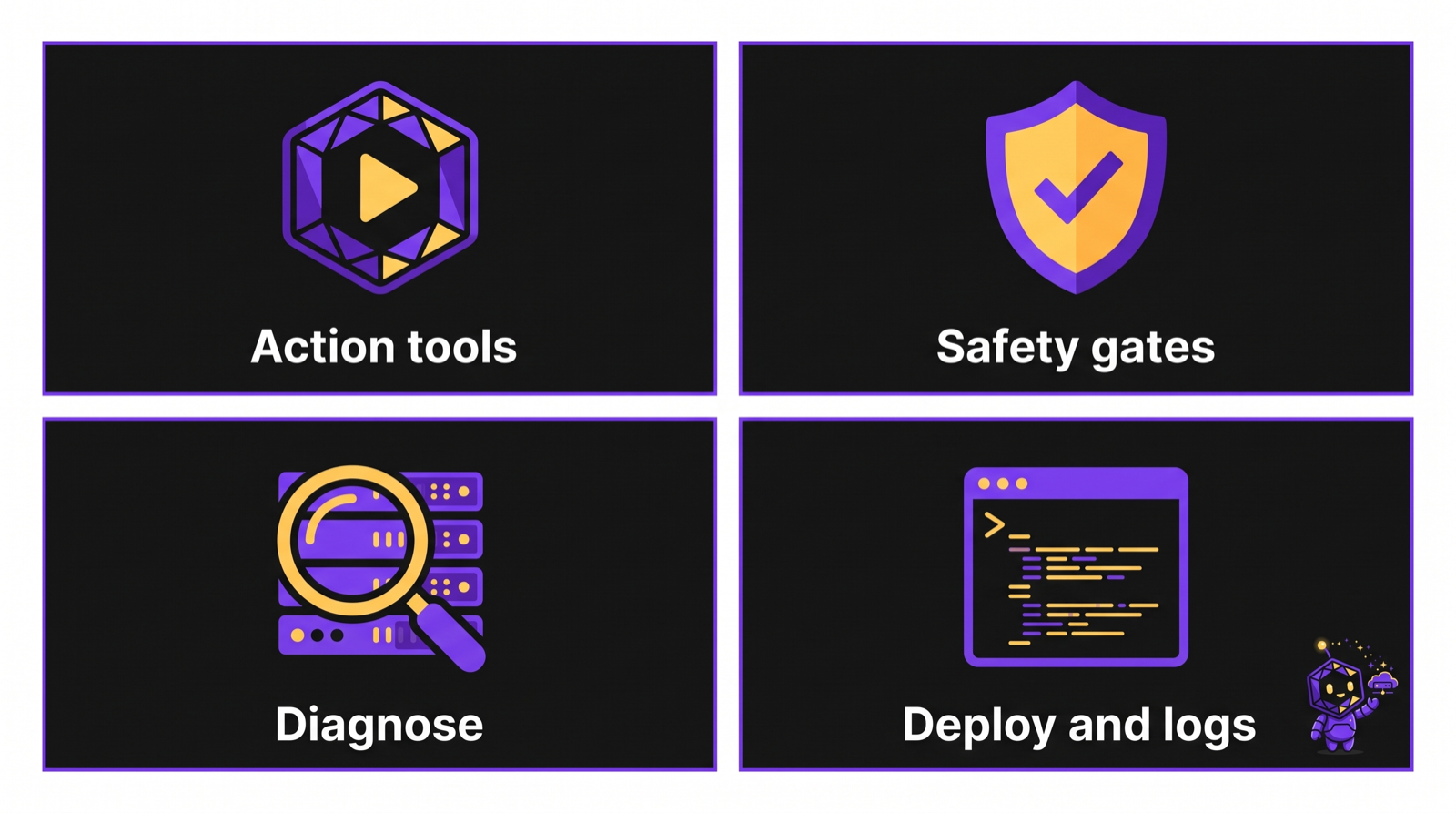
- 18 action-based tools — call
application({ action: "deploy", uuid })instead of hunting through dozens of granular tool names. The registered surface issystem,meta,resource,diagnose,application,emergency,deployment,service,database,private_key,instance,manifest,server,project,environment,docs,recipe, andsetup. - Multi-instance registry & routing — register every Coolify instance you own in
~/.coolify-mcp/instances.jsonvia theinstancetool; per-call credential resolution with no cross-instance leakage. - Coolify Cloud aware —
instance({ action: "cloud-info" })for local discovery, team-scoped tokens, and structured cloud error codes (COOLIFY_CLOUD_FORBIDDEN,COOLIFY_CLOUD_UNSUPPORTED). - Local manifest cache —
.coolify/manifest.jsonsync viamanifest({ action: "sync" }), best-effort auto-hooks on app/service/DB mutations, and_meta.manifestWarningwhen the cache is stale. - Server branding — MCP list icon via
serverInfo.icons(embedded data URI + jsDelivr CDN entries fromdocs/assets/). - Ops workflows that mirror real incidents — a single
system.infrastructure_overviewcall for the big picture, fuzzyresource.findwhen you only remember a name or domain,diagnose.app/diagnose.serverfor a specific suspect, anddiagnose.scanwhen you just know something is wrong fleet-wide. - Deploy lifecycle agents can drive — start/stop/restart, force rebuild,
deployment.watchwith bounded backoff,deployment.logsfor builds, boundedapplication.logs, and runtime follow with idle/overall timeouts. - Full workload CRUD — create, inspect, update, delete, and operate applications, services, and databases; discover live one-click IDs with
service.list-types. - Recipes and guided setup — create git apps, app-plus-database stacks, and one-click services; run
setup.preflight,setup.wire, orsetup.resume; install four matching IDE workflow skills. - Safety by default, not by convention — emergency mutations require an explicit
confirm: true; sensitive keys (password,token,secret,private,env) render as***unless you opt in withreveal: true. - Agent-friendly failure modes — every error is a parseable envelope with a
code, a humanmessage, andrecoveryHints; transient network/429/5xx failures retry automatically with exponential backoff. - Broad client coverage out of the box — Cursor, VS Code / GitHub Copilot, Claude Desktop, Claude Code, Windsurf, and 15+ more via the install configurator.
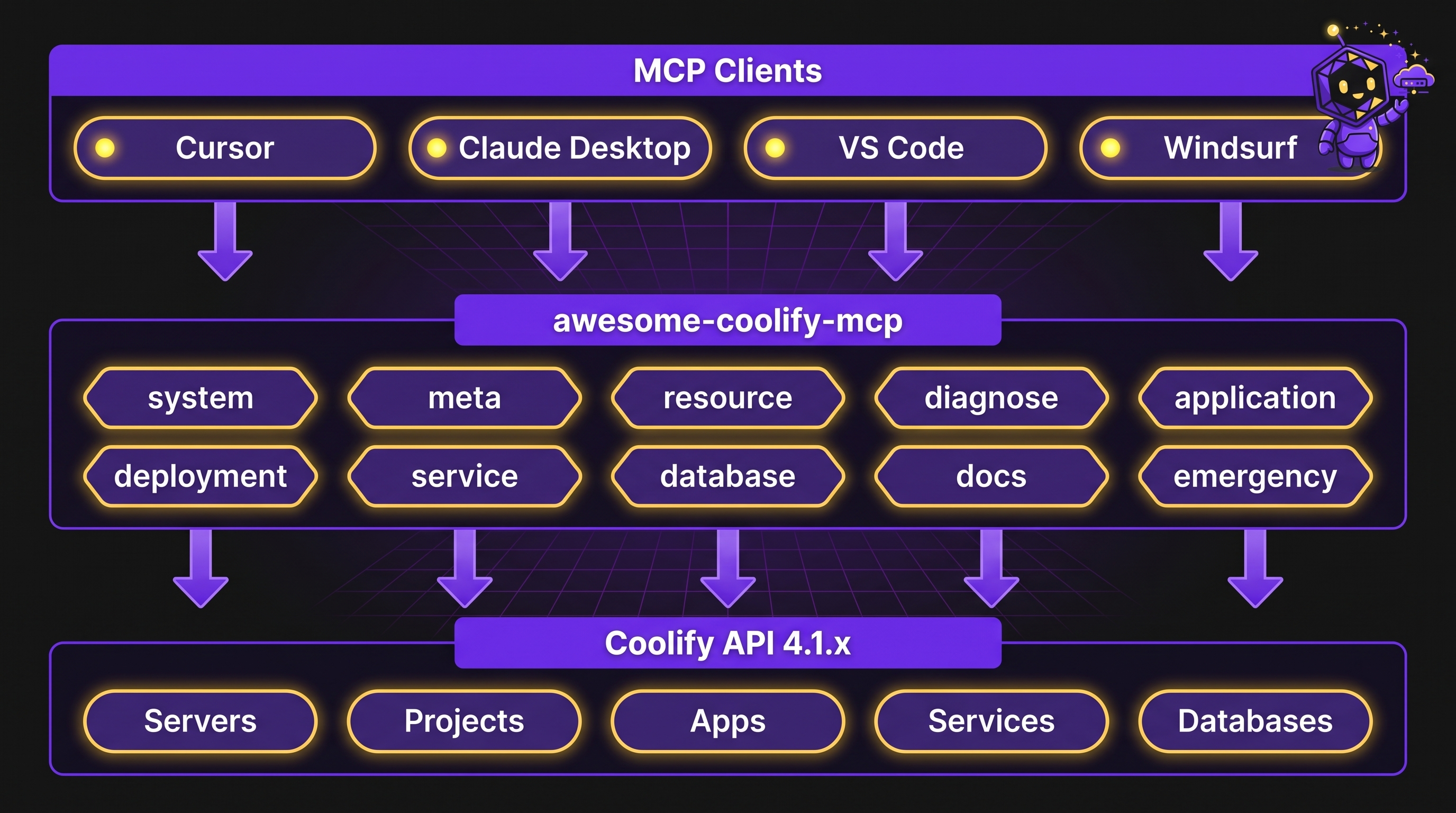
MCP client (Cursor / Claude / VS Code / …)
        │  stdio MCP
        ▼
awesome-coolify-mcp  (18 tools + action discriminator)
        │  optional ~/.coolify-mcp/instances.json resolution
        │  HTTPS + Bearer token
        ▼
Coolify REST API 4.1.x  (servers · projects · applications · services · databases)
The server itself is intentionally boring: it holds no long-lived state and never touches your IDE's config files. Your MCP host (Cursor, Claude, VS Code, …) injects COOLIFY_URL and COOLIFY_TOKEN through its MCP config's env block — or you register named instances in ~/.coolify-mcp/instances.json via the instance tool. The process reads credentials from its environment (or the registry) and forwards authenticated requests to your Coolify instance over HTTPS.
Prerequisites
- Node.js 24+ (Active LTS; CI uses Node 24)
- A self-hosted Coolify instance on 4.1.x
- An API token from Coolify → Keys & Tokens (authorization docs)
Run it directly with npx — no global install needed:
npx -y awesome-coolify-mcpWire the two required environment variables into your MCP host (see Install for every client). Once connected, a minimal smoke test looks like this:
meta({ action: "version" })                       // server identity — no Coolify call
system({ action: "verify" })                      // authenticate + connectivity check
system({ action: "infrastructure_overview" })     // servers, projects, apps, services, DBs at a glance
Note
Multi-instance users: register each Coolify instance first with instance({ action: "add", name, url, token }), then call system({ action: "verify" }). Single-instance setups can skip the registry and use COOLIFY_URL / COOLIFY_TOKEN in MCP env.
Important
Emergency actions (stop_all, redeploy_project, restart_project) require confirm: true. Call them without confirm first — you'll get a would_affect preview and no mutation runs. Only pass reveal: true when you genuinely need plaintext secrets back.
There are three equally supported paths — pick whichever fits your workflow.
Best when you already have your Coolify URL and token handy. Placeholder credentials work fine too — you'll be prompted to fill them in, or you can swap them afterwards.
How these links work (click to expand)
Both editors implement a protocol handler that reads a JSON server configuration straight out of the URL:
| Client | Scheme | Encoding |
|---|---|---|
| Cursor | cursor://anysphere.cursor-deeplink/mcp/install?name=…&config=… (mirrored at https://cursor.com/en/install-mcp?… for a friendlier landing page) |
config is base64-encoded JSON |
| VS Code / Copilot | vscode:mcp/install?name=…&config=… |
config is URL-encoded JSON |
Clicking the button opens your editor, shows the server it's about to add, and lets you review or edit the command/env before accepting — nothing is installed silently.
Use the browser configurator to type in your real COOLIFY_URL / COOLIFY_TOKEN and generate a ready-to-paste snippet for your exact client — JSON, TOML, or YAML depending on what that client expects.
Everything runs client-side in your browser. Your token is never sent to a backend, logged, or stored anywhere but the config file you paste it into.
Paste this into your host's MCP configuration file. Cursor example (~/.cursor/mcp.json for global, or .cursor/mcp.json in a project):
{
  "mcpServers": {
    "awesome-coolify-mcp": {
      "command": "npx",
      "args": ["-y", "awesome-coolify-mcp"],
      "env": {
        "COOLIFY_URL": "https://coolify.example.com",
        "COOLIFY_TOKEN": "YOUR_COOLIFY_API_TOKEN",
        "COOLIFY_VERIFY_SSL": "true",
        "COOLIFY_MCP_LOG": "info"
      }
    }
  }
}
A ready-made copy-paste template also lives at docs/mcp.example.json.
Tip
Using Coolify Cloud? Generate a team-scoped token and follow the registry setup in docs/en/cloud.md.
Install Coolify workflow skills for Cursor, Claude Code, and Codex:
npx skills add clezcoding/awesome-coolify -a cursor -a claude-code -a codexAfter MCP install, run setup({ action: "preflight" }) or see the Setup guide for gh preflight, project linkage, and greenfield provisioning.
| Client | Config location | Notes |
|---|---|---|
| Cursor | ~/.cursor/mcp.json |
One-click deeplink or manual JSON |
| VS Code / GitHub Copilot | .vscode/mcp.json |
Native inputs prompts for URL/token — no plaintext in the file |
| Claude Desktop | claude_desktop_config.json |
Manual JSON or configurator output today |
| Claude Code | ~/.claude.json or .mcp.json |
stdio via npx -y awesome-coolify-mcp |
| Windsurf | ~/.codeium/windsurf/mcp_config.json |
Same npx + env pattern as Cursor |
The install configurator covers a much wider matrix — OpenCode, Codex CLI, Gemini CLI, Cline, Kilo Code, Goose, LM Studio, Hermes Agent, Kimi Code, Google Antigravity, OpenClaw, and more — with the correct config shape for each.
Note
Claude Desktop currently uses manual JSON or configurator output.
| Variable | Required | Default | Description |
|---|---|---|---|
COOLIFY_URL |
yes* | — | Coolify base URL, no trailing slash — e.g. https://coolify.example.com |
COOLIFY_TOKEN |
yes* | — | Bearer API token, scoped to your team |
COOLIFY_VERIFY_SSL |
no | true |
Set to false only for self-signed certs on local/dev instances |
COOLIFY_MCP_LOG |
no | info |
Log verbosity: debug · info · error |
Credentials are read from the process environment (your IDE's MCP env block) or an optional local .env file when running the CLI directly. They are never echoed back inside tool responses.
Note
With the multi-instance registry (~/.coolify-mcp/instances.json), COOLIFY_URL and COOLIFY_TOKEN become optional — the instance tool resolves credentials per call. Env vars remain the simplest path for single-instance setups.
awesome-coolify-mcp works with Coolify Cloud using the same 18 tools — team-scoped tokens, structured cloud error codes (COOLIFY_CLOUD_FORBIDDEN, COOLIFY_CLOUD_UNSUPPORTED), and local instance action cloud-info for discovery.
Run instance({ action: "cloud-info" }) before your first Cloud session — it returns isCloud, resolved url, credential source (registry | env | infer), knownLimits, and a docs link. No live API call.
Full setup, smoke test, and known limits → docs/en/cloud.md
Four parameterized workflow prompts return numbered step guidance (English bodies) that orchestrate existing tools. All arguments are optional — open any prompt without prefill.
| Prompt | Args (all optional) | Purpose |
|---|---|---|
deploy |
instance?, uuid?, force? |
Deploy an application and monitor until terminal status |
diagnose |
instance?, uuid? |
Investigate app, server, or fleet-wide issues |
new-project |
instance?, name?, server_uuid? |
Create project, environment, and optional server linkage |
incident |
instance?, uuid?, project_uuid? |
Triage with diagnose, logs, restart, or emergency redeploy |
Prompt handlers never read .coolify/manifest.json from disk — they steer the agent to resolve UUIDs from manifest or ask the user.
Every domain is exposed as one MCP tool with an action discriminator, so your agent's tool list stays short while the capability surface stays wide.
system({ action: "health" })
application({ action: "deploy", uuid: "<app-uuid>", wait: false })
deployment({ action: "watch", deployment_uuid: "<deployment_uuid>", timeout: 300 })
emergency({ action: "stop_all", confirm: true })Your first call in any session: is Coolify reachable, and what does the fleet look like right now?
| Action | Purpose |
|---|---|
health |
Verify Coolify API reachability |
version |
Coolify instance version string |
verify |
Authenticate; returns connectivity + version in one call |
infrastructure_overview |
Aggregate counts across servers, projects, applications, services, databases |
| Action | Purpose |
|---|---|
version |
awesome-coolify-mcp's own package name + semver — no Coolify call at all |
For when you know roughly what you're looking for but not its exact UUID.
| Action | Purpose |
|---|---|
list |
Applications, services, and databases as summary projections, with pagination _meta |
find |
Fuzzy search by name, domain, or IP across servers and resources — ranked, capped at 10 |
The tool you reach for when something feels wrong but you don't yet know what.
| Action | Purpose |
|---|---|
app |
App status, health, env var count, and recent deployments |
server |
Server resources, domains, and reachability |
scan |
Fleet-wide issues grouped by severity — the "what's on fire" button |
logs |
Resolve an application, return triage context, and optionally include bounded runtime or deployment logs |
| Action | Purpose |
|---|---|
get |
Detailed application configuration |
start / stop / restart |
Container lifecycle control |
deploy |
Trigger a deploy with optional force rebuild; use wait: false + deployment.watch (recommended) or legacy wait: true poll |
logs |
Bounded runtime logs, or bounded follow mode with idle and overall timeouts |
envs:list / envs:get |
List or fetch env vars (values masked as *** unless reveal: true) |
envs:create / envs:update |
Create or update individual env vars (supports is_preview, is_literal, is_multiline, is_shown_once) |
envs:delete |
Delete one env var — requires confirm: true |
envs:bulk-update |
Patch many env vars at once — requires confirm: true |
envs:sync |
Diff/apply a local .env file or inline content — application only; see Resource env vars |
| Action | Purpose |
|---|---|
list |
Deployments for a given application |
get |
Status, commit, and timing details for one deployment |
watch |
Poll until terminal with bounded timeout, backoff, and jitter |
cancel |
Cancel an in-flight deployment cleanly |
logs |
Bounded deployment build logs by deployment UUID, or newest deployment for an application |
After application.deploy with wait: false, call deployment.watch — do not loop deployment.get manually.
| Behavior | Detail |
|---|---|
| Default timeout | 300 seconds |
| Poll interval | Starts at 3s, caps at 30s with equal-jitter backoff |
| Timeout recovery | Re-call deployment.watch with the same deployment_uuid (raise timeout for slow builds) |
| Failed / cancelled | Tool returns a clear error — do not treat as success |
| Legacy | application.deploy wait:true still works but is back-compat only; prefer watch |
application({ action: "deploy", uuid: "<app-uuid>", wait: false })
deployment({ action: "watch", deployment_uuid: "<deployment_uuid>", timeout: 300 })
The shipped IDE skill packs use this same bounded watch flow and document timeout recovery.
| Tool | Actions |
|---|---|
service |
get, start, stop, restart, deploy, create (one-click type XOR compose), update, delete, delete_preview, envs:list, envs:get, envs:create, envs:update, envs:delete, envs:bulk-update |
database |
get, start, stop, restart, create (8 engines), update, delete, delete_preview, envs:list, envs:get, envs:create, envs:update, envs:delete, envs:bulk-update, backup:create, backup:list, backup:update, backup:delete, backup:now, backup:history |
One MCP call to stand up common workload patterns — application + database wiring, git apps, or validated one-click services.
| Action | Purpose |
|---|---|
create-git-app |
Create a git-backed application with local build_pack detection (Dockerfile / Dockerfile.* glob) |
create-app-db |
Create a database + application and wire DATABASE_URL (or custom env_key) between them |
create-one-click |
Create a one-click service after validating type against the live service-templates catalog |
Safety: Recipe creates are intentional — no confirm gate. No dry-run / preview. Partial failure does not auto-rollback; created UUIDs are returned in error.data. Connection strings are masked unless reveal: true.
recipe({ action: "create-git-app", server_uuid, git_repository, git_branch, repo_path: "/path/to/repo" })
recipe({ action: "create-app-db", server_uuid, app_name, db_name, db_engine: "postgresql" })
recipe({ action: "create-one-click", server_uuid, type: "gitea" })
Also use service.list-types to discover valid one-click type IDs before create-one-click.
Manage Coolify runtime configuration on applications, services, and databases through envs:* actions on the existing domain tools — no separate env MCP tool.
| Tool | envs:* actions |
Notes |
|---|---|---|
application |
envs:list, envs:get, envs:create, envs:update, envs:delete, envs:bulk-update, envs:sync |
Only tool with local .env sync |
service |
envs:list, envs:get, envs:create, envs:update, envs:delete, envs:bulk-update |
No sync — use application for .env diff/apply |
database |
envs:list, envs:get, envs:create, envs:update, envs:delete, envs:bulk-update |
is_preview is not supported on database env vars (Coolify OpenAPI gap) |
Confirm gates: envs:delete and envs:bulk-update always require confirm: true on all three tools. On application only, envs:sync requires confirm: true when applying (dry_run: false, the default) or when prune: true.
Reveal policy: Env values render as *** by default. Pass reveal: true only after the human explicitly asks for plaintext — the agent must not auto-set reveal: true.
envs:sync semantics (application only): Supply exactly one of env_file (local path) or env_content (inline .env text). dry_run: true returns a diff (added, updated, unchanged, removed, optional conflicts) with no API writes; default dry_run: false applies changes. Remote keys missing locally are never deleted unless prune: true (also requires confirm: true). When local and remote values differ, set conflict_policy to overwrite, keep_remote, or abort after asking the human — apply with conflicts and no policy returns COOLIFY_CONFIRM_REQUIRED.
application({ action: "envs:list", uuid: "<app-uuid>" })
application({ action: "envs:sync", uuid: "<app-uuid>", env_file: "./.env", dry_run: true })
application({ action: "envs:sync", uuid: "<app-uuid>", env_content: "API_KEY=EXAMPLE_VALUE\n", confirm: true, conflict_policy: "overwrite" })Configure, list, update, delete, and trigger backup schedules — and inspect execution history — on the existing database tool. No separate backup MCP tool.
| Action | Purpose |
|---|---|
backup:create |
Create a backup schedule (frequency required; optional S3, retention, backup_now: true) |
backup:list |
List backup schedules for a database |
backup:update |
Update schedule fields (frequency, retention, S3 flags) |
backup:delete |
Remove a schedule — requires confirm: true |
backup:now |
Trigger an immediate backup run |
backup:history |
List executions for a schedule (status, timestamps, size) |
Parent identity: All backup actions require the parent database via uuid or name. Schedule-scoped actions (backup:update, backup:delete, backup:now, backup:history) also require scheduled_backup_uuid.
Confirm gates: backup:delete requires confirm: true — otherwise COOLIFY_CONFIRM_REQUIRED. delete_s3 defaults false (config-only delete). When delete_s3: true, deletion still requires confirm: true — purging S3 artifacts is treated as destructive.
Frequency (Pitfall 1): backup:create accepts OpenAPI named presets (every_minute, hourly, daily, weekly, monthly, yearly) or a cron expression. backup:update accepts presets only — passing cron on update returns COOLIFY_VALIDATION_ERROR.
backup:now semantics: Maps to Coolify PATCH with { backup_now: true } on the schedule — no separate trigger endpoint. Requires scheduled_backup_uuid.
Reveal policy: S3-related credentials in backup config responses are masked as *** by default. Pass reveal: true only after the human explicitly asks for plaintext — the agent must not auto-set reveal: true.
Out of scope (v2.x+): Backup execution delete, restore/import from backup, and S3 storage destination CRUD are not available in this release.
database({ action: "backup:list", uuid: "<db-uuid>" })
database({ action: "backup:create", uuid: "<db-uuid>", frequency: "daily", save_s3: false })
database({ action: "backup:now", uuid: "<db-uuid>", scheduled_backup_uuid: "<schedule-uuid>" })
database({ action: "backup:delete", uuid: "<db-uuid>", scheduled_backup_uuid: "<schedule-uuid>", confirm: true })Manage Coolify private keys with PEM content masked by default.
| Action | Purpose |
|---|---|
list / get |
List or fetch a key (PEM masked unless reveal: true) |
create / update |
Add or rotate SSH keys |
delete / delete_preview |
Remove a key, or preview dependents before delete |
| Action | Purpose |
|---|---|
get |
Server details, domains, and reachability |
create / update |
Register or reconfigure a server |
validate |
Trigger Coolify's server validation check |
delete / delete_preview |
Remove a server, or preview dependents first |
| Action | Purpose |
|---|---|
list / get |
Discover or inspect projects |
create / update |
Stand up or rename projects |
delete / delete_preview |
Delete a project, or preview blast radius first |
| Action | Purpose |
|---|---|
list / get |
List or inspect environments inside a project |
create |
Add a new environment to a project |
delete / delete_preview |
Remove an environment, or preview dependents first |
| Action | Purpose |
|---|---|
search |
Search a bundled, curated Coolify troubleshooting index — not a live web fetch, so it works offline and can't be used as an external fetch vector |
Reach for these only when you mean it — every action below is behind a confirmation gate.
| Action | Purpose |
|---|---|
stop_all |
Stop every running application, fleet-wide — requires confirm: true |
redeploy_project |
Redeploy every app in a project — requires confirm: true |
restart_project |
Restart every app in a project — requires confirm: true |
Manage named Coolify instances in ~/.coolify-mcp/instances.json. Per-call credential resolution — no cross-instance leakage.
| Action | Purpose |
|---|---|
list |
List registered instances (tokens masked) |
get |
Fetch one instance by name |
add |
Register a new instance (name, url, token, optional type: "cloud") |
update |
Rotate URL or token for an existing instance |
delete |
Remove an instance — requires confirm: true |
set-default |
Set the default instance for ops without an explicit instance param |
import-env |
Opt-in: copy COOLIFY_URL + COOLIFY_TOKEN from process env into the registry |
cloud-info |
Local Cloud discovery — isCloud, url, source, knownLimits, docs link (no API call) |
instance({ action: "add", name: "prod", url: "https://coolify.example.com", token: "<token>" })
instance({ action: "list" })
instance({ action: "cloud-info" })Read/write/sync .coolify/manifest.json — a workspace cache, not source of truth. Remote wins on UUID conflict.
| Action | Purpose |
|---|---|
get |
Read the local manifest file |
upsert |
Merge projects/servers/resources into the cache |
set |
Replace a manifest section |
remove |
Remove a cached resource entry |
clear |
Wipe the manifest — requires confirm: true |
sync |
Reconcile cache against live Coolify API (optional dry_run, prune with confirm) |
diff |
Non-destructive diff report — always safe to run |
manifest({ action: "sync", dry_run: true })
manifest({ action: "diff" })
Note
Best-effort auto-hooks update the manifest after app/service/DB mutations. Stale UUID 404s elsewhere surface _meta.manifestWarning — run manifest({ action: "sync" }) to reconcile.
| Action | Purpose |
|---|---|
preflight |
Check GitHub CLI and workspace prerequisites without changing the project |
wire |
Link an existing workload or provision a greenfield project, with optional domains, env sync, recipe, manifest, and deploy watch steps |
resume |
Continue a paused setup after authentication or another recoverable prerequisite |
wire never auto-pushes. The setup flow pauses cleanly when gh authentication is missing and resumes from completed steps.
The MCP server advertises icons in initialize via an embedded PNG data URI (primary) and jsDelivr CDN URLs for mcp-icon-192.png and favicon-32.png. Cursor may still show a letter fallback — see maintainer verify record. Not a Coolify API call.
Destructive emergency actions follow a strict two-step pattern:
- Call with
confirmomitted orfalse→ you get back awould_affectpreview and error codeCOOLIFY_CONFIRM_REQUIRED— nothing is mutated. - Call again with
confirm: true→ the action actually executes.
Regular app/service/database mutations (start, stop, deploy, …) are not behind this gate — they simply follow Coolify's own API semantics, since they're scoped to one resource rather than your whole fleet.
Environment variables: envs:delete and envs:bulk-update require confirm: true on application, service, and database. envs:sync apply (dry_run: false) and envs:sync with prune: true require confirm: true on application only. dry_run: true sync previews never mutate.
- Keys matching
password,token,secret,private, orenvrender as***by default in tool output. - Pass
reveal: trueonly when you explicitly need plaintext — for example, to copy an env var into another system. Ask the human first before settingreveal: trueon anyenvs:*call. - Log line bodies are not masked. Treat raw logs like you would any other sensitive output: don't paste them into long-lived agent memory or public tickets.
Warning
Registry files (~/.coolify-mcp/instances.json) are written with 0o700 directory and 0o600 file permissions. Tokens are never echoed in tool output unless you explicitly pass reveal: true.
Every API failure comes back as a parseable envelope your agent can reason about, instead of a raw stack trace:
{
  "code": "COOLIFY_401",
  "message": "Unauthorized — invalid or expired API token",
  "recoveryHints": [
    "Verify the token in Coolify UI → Keys & Tokens",
    "Ensure the token has the required team permissions"
  ],
  "httpStatus": 401
}| Code | Meaning |
|---|---|
COOLIFY_401 |
Invalid or missing token |
COOLIFY_404 |
Resource not found |
COOLIFY_422 |
Validation error |
COOLIFY_500 |
Coolify server error |
COOLIFY_NETWORK |
Connection failed |
COOLIFY_TIMEOUT |
Request timed out |
COOLIFY_CONFIRM_REQUIRED |
Emergency preview — pass confirm: true to proceed |
COOLIFY_AMBIGUOUS_MATCH |
Name matched multiple resources — pick a UUID from the ranked list |
COOLIFY_CLOUD_FORBIDDEN |
Cloud token or team permission issue (HTTP 403) |
COOLIFY_CLOUD_UNSUPPORTED |
Endpoint not available on Coolify Cloud (HTTP 404) |
Transient failures (HTTP 429, 5xx, or network errors) retry automatically up to 3 times with exponential backoff (1s → 2s → 4s) before giving up and returning the error to your agent.
"Is my Coolify reachable, and what do I have?"
system({ action: "verify" })
system({ action: "infrastructure_overview" })
resource({ action: "list" })
"Find the nginx app, deploy it, then show me the logs."
resource({ action: "find", query: "nginx" })
application({ action: "deploy", uuid: "<uuid>", wait: false })
deployment({ action: "watch", deployment_uuid: "<deployment_uuid>", timeout: 300 })
application({ action: "logs", uuid: "<uuid>" })
"Something feels wrong across the fleet."
diagnose({ action: "scan" })
diagnose({ action: "app", uuid: "<suspect>" })
diagnose({ action: "server", uuid: "<server>" })
"Emergency: stop everything, but let me see the blast radius first."
emergency({ action: "stop_all" })                 // preview — would_affect, no mutation
emergency({ action: "stop_all", confirm: true })  // execute
"Multi-instance: list registered instances and verify each."
instance({ action: "list" })
system({ action: "verify" })Package 1.1.0 ships 18 tools and four MCP prompts for Coolify API 4.1.x:
| Capability | Status |
|---|---|
| Verify connectivity + infrastructure overview | ✅ Shipped |
Discovery: resource.list / resource.find |
✅ Shipped |
| Diagnose: app, server, fleet-wide scan + follow-up hints | ✅ Shipped |
| Deploy lifecycle: start/stop/restart, deploy with wait-mode + force rebuild | ✅ Shipped |
| Deployment tracking: list / get / cancel | ✅ Shipped |
| Deployment watch and bounded build logs | ✅ Shipped |
Application runtime logs, bounded follow, and diagnose.logs |
✅ Shipped |
| Application, service, and database CRUD | ✅ Shipped |
| Dynamic one-click type discovery and recipes | ✅ Shipped |
| Setup wizard and four IDE workflow skills | ✅ Shipped |
| Emergency ops: stop-all, project redeploy/restart, behind confirm gate | ✅ Shipped |
SSH key CRUD (private_key) with PEM masking |
✅ Shipped |
Server CRUD + validation (server) |
✅ Shipped |
Project & environment CRUD (project, environment) |
✅ Shipped |
Secret masking with explicit reveal opt-in |
✅ Shipped |
| Structured errors, recovery hints, automatic retries | ✅ Shipped |
| npm distribution + install configurator for 15+ clients | ✅ Shipped |
Multi-instance registry (instance, instances.json) |
✅ Shipped |
Coolify Cloud path (cloud-info, team-scoped tokens) |
✅ Shipped |
Local manifest sync (.coolify/manifest.json, auto-hooks) |
✅ Shipped |
Live UAT harness (npm run uat:live) |
✅ Shipped |
Capability discovery via system.version |
✅ Shipped |
Deployment build logs via deployment.logs |
✅ Shipped |
Capability discovery & build logs:
system({ action: "version" })returnscoolifyVersion(replacing the legacyversionfield),mcpVersion, and acapabilitiesmap of Coolify 4.1.2 feature flags. For app triage + bounded runtime tail in one call, usediagnose({ action: "logs", mode: "full", uuid: "..." })— checkcapabilities.diagnose_logs. For deployment build logs, preferdeployment({ action: "logs", deployment_uuid: "..." })(orapplication_uuidto resolve the newest deployment). Theapplication.logspath withdeployment_uuidstill works for back-compat. For runtime log follow, useapplication({ action: "logs", uuid: "...", follow: true })— bounded MCP polling until idle or timeout; checkcapabilities.application_logs_followviasystem.version.
Warning
Coolify 4.1.x does not expose stable service or database log endpoints. This server therefore does not claim or register service/database log actions. Use application runtime logs and deployment build logs until compatible upstream APIs are available.
Future work stays bounded by verifiable upstream and repository constraints:
- Add service/database logs when compatible Coolify APIs are stable and available.
- Close tracked REST mappings in
docs/COVERAGE.mdwhere they add useful agent workflows. - Revisit cross-instance fan-out only with explicit rate-limit and credential-isolation guarantees.
No release date or compatibility promise is attached to these boundaries. Use GitHub Issues for concrete requests.
git clone https://github.com/clezcoding/awesome-coolify.git
cd awesome-coolify
pnpm install
pnpm run build    # tsup → dist/
pnpm test         # vitest
pnpm run dev      # watch mode
Logs go to stderr only — stdout is reserved exclusively for the MCP protocol.
The maintainer publish flow (build → pack --dry-run → publish) is documented in CONTRIBUTING.md.
Note
Maintainers can run live UAT against a real Coolify instance with npm run uat:live. See CONTRIBUTING.md — Live UAT Harness for prerequisites and report output — do not duplicate the runbook here.
| Resource | URL |
|---|---|
| Install configurator | clezcoding.github.io/awesome-coolify/install.html |
| Install landing page | clezcoding.github.io/awesome-coolify/ |
| Example MCP JSON | docs/mcp.example.json |
| Brand assets | docs/assets/ |
| Coolify | coolify.io |
| MCP specification | modelcontextprotocol.io |
| Issues & feature requests | GitHub Issues |
| Contributing | CONTRIBUTING.md |
| Changelog | CHANGELOG.md |
| Security policy | SECURITY.md |
| License | MIT |