When one AI agent hands work to another, the frameworks we tested don't check the second one's
permissions against the first one's. attenu-guard gives it the permissions you declare for its task, never more than the
parent holds, and refuses the rest,
inside your process, with no network call in the deny path. Every check(), allowed or denied,
lands on a hash-chained log you can verify offline.
It is for people building agents that hand work to other agents.
Apache-2.0 · Python 3.9+ · zero runtime dependencies · TypeScript port:
attenu-guard-ts, on npm as attenu-guard
attenu.io · Docs · Attenu Derive — what each agent may do, read from your app · Internet-Draft · Changelog
pip install attenu-guardfrom attenu_guard import Authority, Guard, RowLimit, AuthorityDenied
# The orchestrator holds broad authority.
parent = Guard.issue("orchestrator", Authority(
scopes={"crm.*", "mail.send"}, ceilings=[RowLimit(100_000)], ttl=3600))
# It delegates a narrow task. The child gets the meet of what the parent held
# and what the task needs, computed and enforced, not suggested.
child = parent.delegate("summarizer", Authority(
scopes={"crm.read"}, ceilings=[RowLimit(5_000)], ttl=900), task="summarize Q3")
print(child.check("crm.read", context={"rows": 4_200}))
try:
child.enforce("crm.export")
except AuthorityDenied as denied:
print(denied)Prints:
Decision(allowed=True, reasons=(), determining_node='chain:n1', call_id=None)
denied: scope_not_granted requested=crm.export: scope 'crm.export' not covered by held scopes ['crm.read']
check() returns a Decision with machine-readable reason codes for your audit trail,
enforce() is the hard-stop gate that raises, and would_allow() is a dry-run that writes
nothing. The export is refused because the sub-agent never held that permission, so an injected
instruction has nothing to widen.
Adapters for 19 frameworks and the A2A protocol, each integrated unmodified, each with offline
tests, and all but OpenHands and AstrBot with an offline demo (matrix); install one with
pip install 'attenu-guard[<extra>]'. MCP is a recipe rather than an adapter: a server that
verifies the delegation chain before it runs a tool
(server verifier).
Enforced live on Google's published adk-samples customer-service and financial-advisor apps,
denying a real model mid-run
(evidence). The same
adapters run live on CrewAI and LangGraph, on crews and graphs we built for a travel-booking domain
rather than on third-party apps.
A3 states that limit.
Have a bundle to check?
pipx run attenu-guard verify bundle.jsonchecks integrity, child ⊆ parent and containment from the file alone, no account, no network. The auditor's walkthrough has three sample bundles (clean, tampered, widened) and takes a minute.
Just want to see it run? Clone the repo (
git clone https://github.com/attenu-io/attenu-guard && cd attenu-guard); no install needed, the examples bootstrap thesrc/path themselves:python3 examples/poisoned_summarizer.py, andpython3 tests/run_properties.pyfor the invariants.
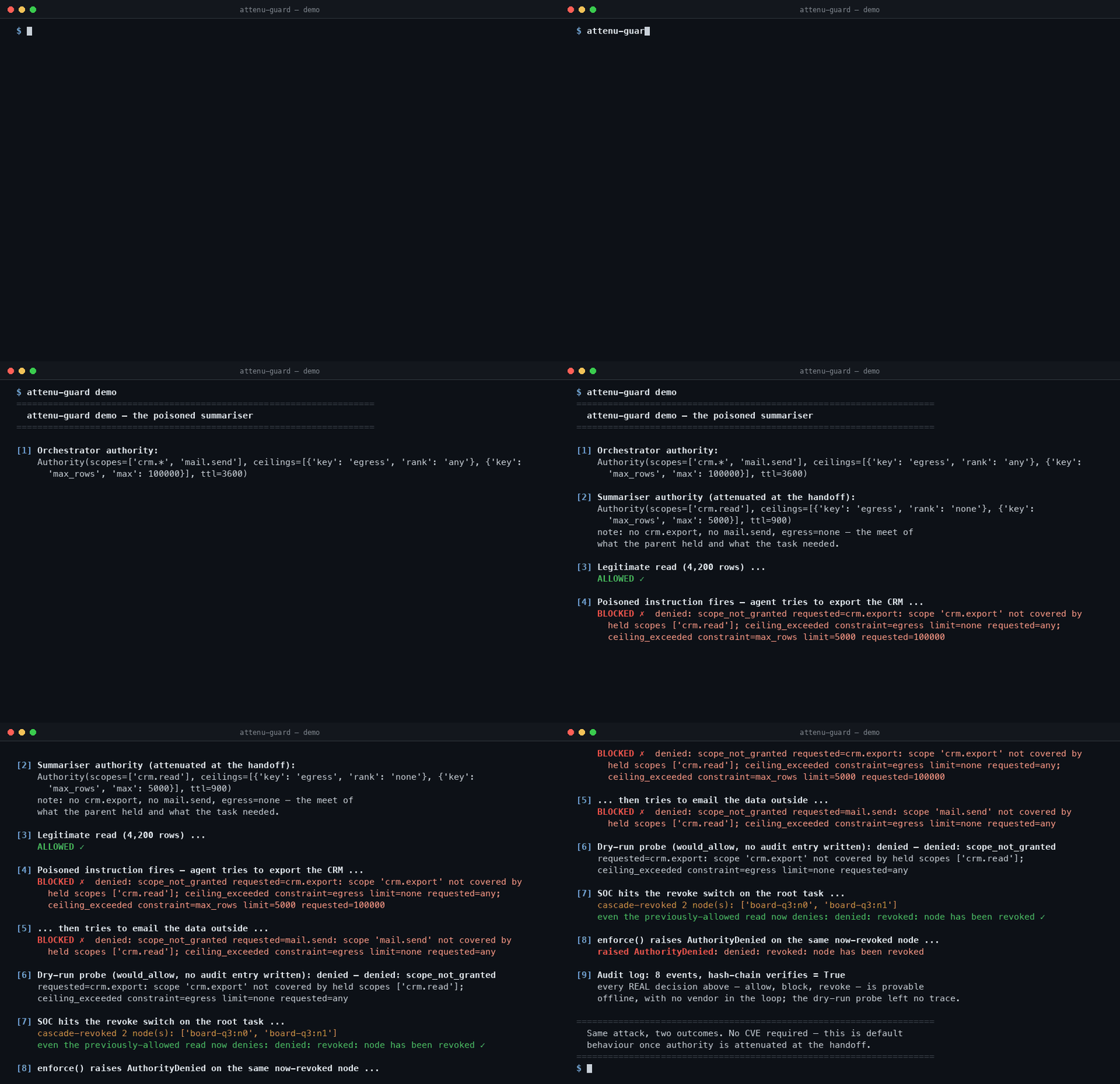
An open enforcement layer for OWASP ASI07 (insecure inter-agent communication) and ASI08 (cascading failures): delegated authority stays inside the parent's limits, and every check the guard records stays verifiable offline.
In the frameworks we audited, the handoff itself is not something the system can see: identity tokens describe two parties — user and agent — so "child ⊆ parent" cannot be written down, and policy checks fire when a tool is invoked rather than at the moment permissions are passed down. Verified against released code, and pinned by tests that fail the day the behaviour changes:
| System | What it does at a handoff (framework rows verified against the released code — see docs/INTEGRATIONS.md; the identity and protocol rows are from their published specs) |
|---|---|
| OpenAI Agents SDK 0.22 | passes the entire conversation to the sub-agent (Handoff.input_filter=None by default: "the new agent sees the entire conversation history"); no parent/child relation exists, so nothing checks child ⊆ parent |
LangChain deepagents 0.7 |
a sub-agent's permissions replace the parent's rules entirely (graph.py) — a child can be granted what its parent is denied |
| Google ADK 2.7.1 | disallow_transfer_to_peers is enforced on the legacy llm_flows path since 2.7.1 (#3850, fix fa18d26a) — but the 2.x default workflow path (workflow/utils/_transfer_utils.py, sibling case) still carries no check: on 2.7.1 the peer transfer goes through (pinned by tests/integrations/test_google_adk.py, which fails the day it stops). Either way ADK checks who may transfer; it does not check what authority passes, and no record exists to verify afterwards |
| CrewAI 1.15 | a delegated coworker runs with its own full tool list; the tool-hook dispatcher swallows exceptions and runs the tool (fail-open) unless you raise its one blessed exception |
| AutoGen 0.7 | Handoff carries target/description/message only; the receiver offers the model its own full tool list |
| Microsoft Entra | the parent→child construct has two settings, all allowed or none; it cannot express child ⊆ parent (details) |
| MCP | scope flow is accumulation-biased (step-up unions); the request carries no agent authority at all: CallToolRequestParams has name, arguments, meta, task and nothing that says which agent is calling with how much of it. Shipped here as a recipe rather than an adapter, a server that verifies the chain before it runs a tool (server_verifier) |
| A2A | authenticates the hop, carries no delegated authority |
attenu-guard makes child ⊆ parent a computed, enforced, offline-verifiable invariant — in your framework, in your process — no proxy, and no network call in the deny path.
Authority— an immutable capability (scopes + a list of typed, extensibleCeilingbounds + TTL) withmeet, the lattice operation that can only ever shrink, andis_narrower_than, the provable subsumption relation.Guard—issue()a root,delegate()a sub-agent with attenuated authority,check()→Decision,enforce()→ raises,would_allow()→ dry-run,revoke()a whole subtree.- Typed ceilings —
RowLimit,SpendCap,CallLimit,EgressRank,Allow,Deny,Prefix, or your own viaregister_ceiling. Unknown ceiling types fail closed, never silently unbounded. - Chain invariants — depth, fanout, and aggregate budget ceilings; cascade revocation (revoke any node, every descendant denies immediately).
- Hash-chained audit log — an open, versioned schema;
attenu-guard view log.jsonlrenders the tree and verifies it; tampering is provable offline. Everydenysays why (disposition:held_pending_grant— waiting on a human ·withheld_tier2·unresolved— no authority known for the tool ·out_of_authority— real over-reach), so "held" never reads as "denied";evidence.export_bundle/verify_bundle/delegation_graph/denialsgive an auditor an offline-verifiable bundle and the folds a console renders. The bundle proves authorization and lifecycle, not execution or outcome — see what the evidence does not prove.AuditLog(sinks=…)copies entries to local sinks after the write (never the network) —sinks.SpoolSinkis a bounded, fsync'd, resumable write-ahead spool carrying the ingest idempotency key(boot_id, chain_id, seq, hash);attenu_guard.identitygives a product an identity before it has a key (.attenu/product.json, per-processboot_id, assigned chain ids). - Wire format (
attenu_guard.wire) —serialize/loadthe delegation chain as signed Delegation Tokens and verify child ⊆ parent offline, across services, with no authorization server in the path. This is the reference implementation of the current working Internet-Draft indocs/; 20 interop test vectors live intests/vectors/and ship inside the installed package asattenu_guard.vectors, so an implementation in any language can score its own verifier with nothing butpip install attenu-guard. - Scenario harness — declarative JSON/YAML authorization tests (
attenu-guard scenarios file.json); seescenarios/. - Adapters — shipped, tested integrations for the major agent frameworks as
attenu_guard.adapters.<name>: LangGraph, LangChaincreate_agent/ deepagents, OpenAI Agents SDK, Google ADK, Pydantic AI, CrewAI, AutoGen, Microsoft Agent Framework, AG2, Claude Agent SDK, smolagents, AWS Strands, LlamaIndex, Semantic Kernel, Agno, Haystack, CAMEL-AI, OpenHands, AstrBot — and, for the A2A protocol, a client interceptor plus a guardedAgentExecutorthat carries the attenuated chain across a hop between processes. Each has offline tests, and all but OpenHands and AstrBot have an offline demo underexamples/integrations/; install one withpip install 'attenu-guard[<extra>]'. Hooks, versions and what each framework enforces itself:docs/INTEGRATIONS.md.
You do not have to decide a policy to get value out of this. Point it at agents that already exist, let every call through, and read what they did. Nothing is refused, so there is nothing to get wrong.
from attenu_guard import Authority, Guard

# Wide on purpose: you are watching, not gating.
# Note the scope grammar: "*" is only valid as the final segment, so list the
# families your app uses. A bare "*" is rejected.
WIDE = Authority(scopes={"crm.*", "mail.*", "fs.*"}, ceilings=[], ttl=3600)

root  = Guard.issue("orchestrator", WIDE, max_depth=4)
child = root.delegate("summarizer", WIDE, task="summarize")

child.check("mail.send")          # allowed, and recorded

for e in root.audit_log().entries:
    print(e.get("event"), e.get("node"), e.get("scope"))
root chain:n0 None
spawn chain:n1 None
allow chain:n0 crm.read
allow chain:n1 crm.read
allow chain:n1 mail.send
Every hand-off and every call is on the hash-chained log, with the parent each child came from. Read it, and you can see whether a child ever made a call its parent would not have been allowed to make. Then narrow the authorities and the same code starts refusing.
On somebody else's app, you will not know the tool names in advance. The adapters
take two hooks for exactly this: default_policy(tool_name) -> ToolPolicy and
default_subagent_authority(name) -> Authority. When nothing was declared for a tool
or a sub-agent, the hook's result is used as if it had been, so the call is authorized
and recorded with a generated scope instead of denied. default_policy takes
precedence over allow_unlisted, which silently passes unlisted tools without
recording a scope for them.
What this does not do. A wide authority is a choice you are making, not a magic
pass: a tool that is listed and falls outside the authority still denies. Observe
mode changes what you declare, not how check() decides. And a call that never
reaches the hook is neither recorded nor refused — see
docs/THREAT-MODEL.md.
Versions 0.7 and later use RFC 8785 JCS for every
signed or hash-linked artifact: Delegation Token protected headers and payloads,
parent commitments, integrity seals, audit entries, anchors, and evidence bundles.
Tokens and metadata-bearing artifacts emit "c14n":"JCS" as an informational
label. Verifiers enforce JCS from canonical bytes and hashes, not from that label;
non-canonical input, duplicate object member names, non-finite numbers, and lone
UTF-16 surrogates are rejected.
This is a deliberate wire-format break from versions through 0.6.1. Current versions have no legacy or dual-format reader. Producers and verifiers in different languages must move together; the 20 packaged interop vectors pin the required bytes and rejection reasons.
git clone https://github.com/attenu-io/attenu-guard && cd attenu-guard
python3 tests/run_properties.py      # 4,000 random delegation trees per invariant, zero deps
python3 tests/red_team.py            # 17 adversarial attacks, black- & white-box; 0 must break
python3 examples/poisoned_summarizer.py
attenu-guard demo                    # needs pip install attenu-guard
The property suite asserts — over thousands of random chains — that attenuation
never widens, holds transitively down a chain, that a revoked subtree authorizes
nothing, and that audit tampering is detected. The red-team harness (see
docs/RED-TEAM.md) additionally tries to break the protocol
— privilege escalation, chain splicing, expired-grant reuse — and every genuine
finding is fixed and pinned as a regression. If you can break one, the core claim
is false; please tell us.
Runs, not claims, on what each agent framework does at a handoff — one post per finding, versions pinned, output pasted: attenu.io/blog (feed). Start with Does a sub-agent inherit its parent's permissions? Five frameworks, five answers.
The protocol is designed to be IETF-acceptable: it reuses the OAuth/JOSE stack
(JWT, RFC 9396 authorization_details, DPoP, Token Status List) and invents only
the one missing piece — cryptographically-linked, subsumption-enforced, offline
multi-hop attenuation. See docs/STANDARDS-ALIGNMENT.md
and the Internet-Draft draft-asor-wimse-agent-delegation-chain (published revision -01, individual submission, targeting the WIMSE working group; source in docs/).
This library does not decide authority for you. You write the Authority for
each delegation — or you let attenu-derive,
the open engine, compute it from your app's declared structure (agents, roster, tools,
what each task calls) and approve it before it is enforced. The library is the
enforcement shim and the open schema; it is useful entirely on its own, forever, with
no account and no network. Attenu also has a console for denials and decisions. It is not
public yet, and it is never in the deny path.
attenu-guard only sees calls that go through its hook. A tool called some other way is neither refused
nor logged, and an allow means authorized, not executed. See
docs/THREAT-MODEL.md and the documented limitations in
docs/RED-TEAM.md.
Apache-2.0. Contributions under the DCO. Security policy in SECURITY.md.