This repository contains the dataset reported in the paper. For further information please visit DOI or video.
Capacitive touchscreens are near-ubiquitous in today’s touch-driven devices, such as smartphones and tablets. By using rows and columns of electrodes, specialized touch controllers are able to capture a 2D image of capacitance at the surface of a screen. For over a decade, capacitive "pixels" have been around 4 millimeters in size – a surprisingly low resolution that precludes a wide range of interesting applications. In this paper, we show how super-resolution techniques, long used in fields such as biology and astronomy, can be applied to capacitive touchscreen data. By integrating data from many frames, our software-only process is able to resolve geometric details finer than the original sensor resolution. This opens the door to passive tangibles with higher-density fiducials and also recognition of every-day metal objects, such as keys and coins. We built several applications to illustrate the potential of our approach and report the findings of a multipart evaluation.
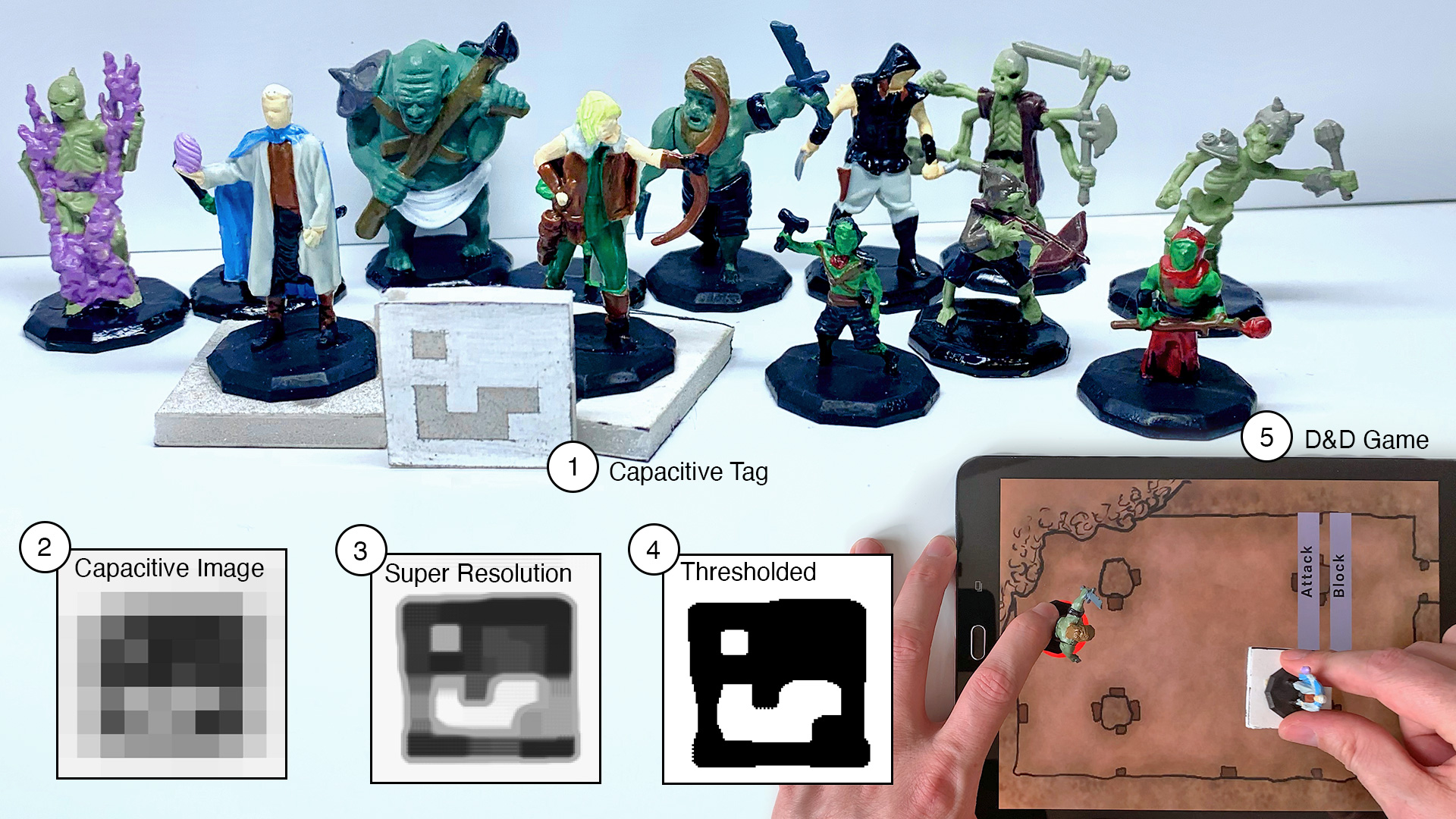
This work can be cited as follows:
@inproceedings{mayer2021super,
title = {Super-Resolution Capacitive Touchscreens},
author = {Mayer, Sven and Xu, Xiangyu and Harrison, Chris},
doi = {10.1145/3411764.3445704},
year = {2021},
date = {2021-05-08},
booktitle = {Proceedings of the 2021 CHI Conference on Human Factors in Computing Systems},
publisher = {Association for Computing Machinery},
address = {New York, New York, USA},
series = {CHI '21},
}