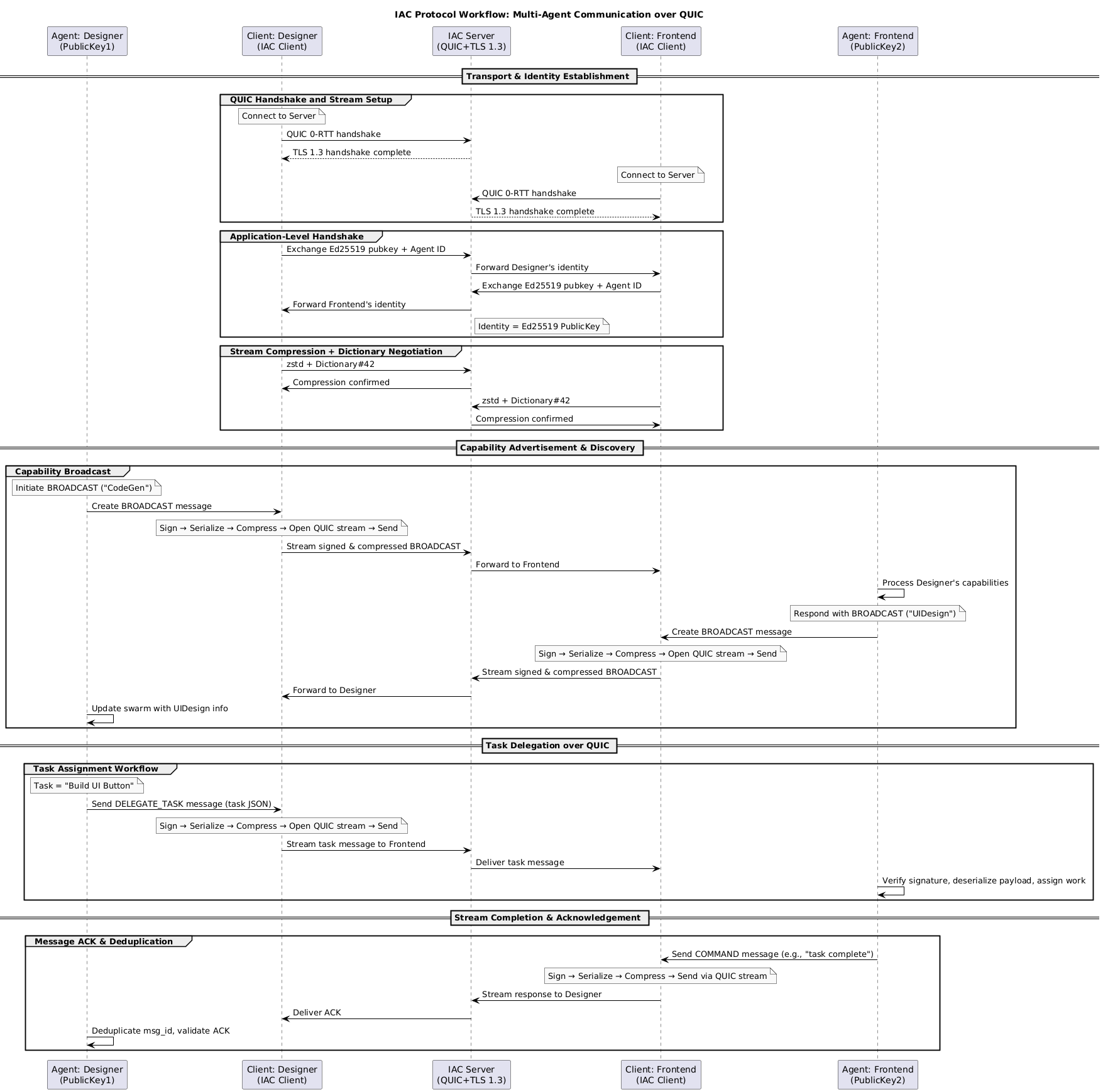
In multi-agent ecosystems such as AutoGPT, agents act autonomously yet must reliably collaborate. The IAC (Inter & Intra Agent Communication) Protocol thus represents a foundational leap forward in agent networking. Building upon traditional IPC concepts, IAC is reinvented through the application of QUIC (TLS 1.3 over UDP), strategic cryptographic identity, and baked-in efficiency layers. The result is an ecosystem-agnostic channel through which agents, whether collocated or distributed globally, communicate with sub-millisecond latency, near-native bandwidth efficiency, and cryptographic authenticity. By turning away from REST, gRPC, and bare TLS/TCP architectures, IAC becomes the foundation of a future where trillions of bounded agents can handshake, exchange, and batch work in a mesh topology with resilience and clarity.
While conventional REST APIs and message queues dominate today's architectures, they expose critical friction points under demanding conditions:
- Handshake delays: TCP and TLS incur at least one RTT (round-trip time) to initiate. Frequent connection init cycles add up, particularly in IoT environments.
- Head-of-Line blocking in TCP: Even multiplexed frameworks like HTTP/2 can be balked when a delayed packet holds entire streams hostage.
- Stateless token auth: Reliance on bearer tokens or API keys lacks granular revocation control, fails cryptographically-proof identity continuity, and scales poorly when agents turn over rapidly.
- Orchestrator-centric models: REST and RPC assume a central service; they lack built-in peer-to-peer elasticity, a core requirement for mesh-based systems.
IAC addresses all these limitations in a holistic architecture. QUIC's 0-RTT capability eliminates the handshake cold-start, and its multiplexed streams dodge TCP's halting weakness. Cryptographic signing and identity mitigate token-based attack surfaces. And native peer-to-peer connections allow grids of agents to organize, delegate, and redundantly replicate tasks without centralized bottlenecks.
Derived from the spectral performance of QUIC atop UDP, IAC defaults to QUIC with TLS 1.3 for its handshake and connection lifecycle. Benefits include:
- Zero RTT setup: Optionally reuse previous session parameters for near-instant reconnection.
- Multi-stream concurrency: No HOL blocking; Each agent stream proceeds independently.
- Faster loss recovery: QUIC's ACK-based fast retransmit is more adaptive to packet loss.
- Integrated congestion control: Out-of-the-box BBR ensures throughput remains smooth at scale.
Agents gracefully degrade to TLS/TCP or UNIX-domain sockets as network or deployment requires, preserving compatibility with firewalls or co-located execution.
A public-private keypair (Ed25519 seed) is mined at agent runtime. The public key doubles as the agent's unique identity, eliminating ambiguous token systems. During handshake, peers exchange and validate keys; every message thereafter is signed and optionally encrypted. This yields:
- Unforgeable provenance: Only the private-key owner can generate valid agent messages.
- Forward secrecy: Ephemeral session data cannot be retroactively decrypted by eavesdroppers.
IAC integrates batch messaging, stream multiplexing, dictionary-driven compression, and congestion pacing. The goal: every byte, every millisecond, optimized with forethought and control.
Every session begins by negotiating the transport stack:
-
Client attempts QUIC handshake using native certificate trust roots.
-
Negotiation includes compression preference (zstd) and dictionary ID.
-
Upon failure or policy constraints, fallback can be:
- TLS/TCP with full-stream multiplexing.
- UNIX socket/shared memory used within colocated contexts.
-
Concurrency: QUIC allows simultaneous handshake, stream-open, and data exchanges via distinct virtual streams.
This layered fallback enables robust deployment across edge nodes, cloud-bound agents, and local orchestrators.
syntax = "proto3";

package iac;

enum MessageType {
  UNKNOWN = 0;
  PING = 1;
  BROADCAST = 2;
  FILE_TRANSFER = 3;
  COMMAND = 4;
  DELEGATE_TASK = 5;
}

message Message {
  string from = 1;
  string to = 2;
  MessageType msg_type = 3;
  string payload_json = 4;
  uint64 timestamp = 5;
  uint64 msg_id = 6;
  uint64 session_id = 7;
  bytes signature = 8;
  bytes extra_data = 9;
}from,to: agent identities as hex-encoded public-keys or DNS-like aliases.msg_type: designates intent (e.g. MessageType::DELEGATE_TASK, MessageType::PING).payload_json: UTF-8 serialized metadata or control-object.extra_data: opaque binary; may carry compressed frames, file chunks, stream tokens.
Supplementing canonical encoding, a binary payload (e.g., msg.sign()) is serialized via Protobuf and then optionally compressed. High-frequency workloads dramatically benefit from =85% payload reduction via dictionary reuse.
Every message holds a signature using Ed25519 for symmetric environments. The signing flow:
- Clone the message and zero the
signaturefield. - Serialize via Protobuf.
- Sign the serialized data, writing bytes back to
signature. - Receiver performs equivalent zero, serialize, and verify signature.
This ensures authenticated immutability and safeguards inter-agent trust. Channel-level TLS protects data in flight; message-level signatures protect agent locality. With static key rotation allowed, backward traceability and auditability remain intact.
- Inter-Agent: global mesh using QUIC; agents broadcast, delegate, or proxy routing messages.
- Agent-Orchestrator: hierarchical or peer-centered delegation; orchestrator acts as bootstrap/registry.
- Intra-Agent: CPU-local using shared IPC primitives or UDS for low-latency ping/pong.
Upon initial connection:
- QUIC handshake authenticates raw channel.
- Application-level handshake:
- Exchange of agent IDs / public keys within secure stream.
- Validation against orchestrator's registry or known set.
- Compression dictionary selection.
- Session-level symmetric key derivation if needed.
- Each logical request (e.g.,
msg_type = MessageType::DELEGATE_TASK) uses a new QUIC unidirectional stream. - Low-overhead messages are batched and flushed together.
- Stream includes: Protobuf frame, optional compression header, binary chunk.
- Congestion is paced via BBR controls; handshake prevents bursts.
- zstd is negotiated on every session.
- Dictionary-based compression allows high gains, especially for repetitive agent payloads.
- Compression is applied post-serialization but pre-stream dispatch.
Fields:
timestamp: microsecond precisionmsg_id: wrap-around-monotonic countersession_id: unique per connection
Receiver-side buffer tracks:
- Cached msg_ids to drop duplicates.
- Out-of-order detection with epoch window.
- Adaptive reorder buffer based on network variance.
IAC abstracts chunking and receipt acknowledgment:
msg_type=MessageType::FILE_TRANSFER: includes filename, index, total, checksum in JSON.extra_datacarries raw chunk (compressed).
| Feature | REST / gRPC | IAC (TLS/TCP) | IAC (QUIC) |
|---|---|---|---|
| TLS 0-RTT | ❌ | ❌ | ✅ |
| Stream Multiplexing | ❌ | ❌ | ✅ (ho-free multi-streams) |
| Agent Identity | API tokens | Bearer tokens | ✅ (Key-pair crypto-identity) |
| Mesh Support | ❌ | Partial | ✅ (Built-in P2P delegation) |
| Compression | ❌ | ❌ | ✅ (zstd + dictionaries) |
| File transfer support | ❌ | ❌ | ✅ (chunking + shared-mem) |
| Dedup/Reorder | ❌ | ❌ | ✅ (Protocol-level reliability) |
IAC redefines the foundation of agent communication in a modern, distributed landscape, delivering exceptional performance, cryptographic integrity, and scalable design. It supports use cases ranging from decentralized AutoGPT swarms to ultra-responsive IoT coordination, all while maintaining the robustness and semantic clarity required for global-scale systems. Rather than offering a marginal improvement, IAC represents a fundamental shift, a protocol built not for the past, but for the future of intelligent agents.